
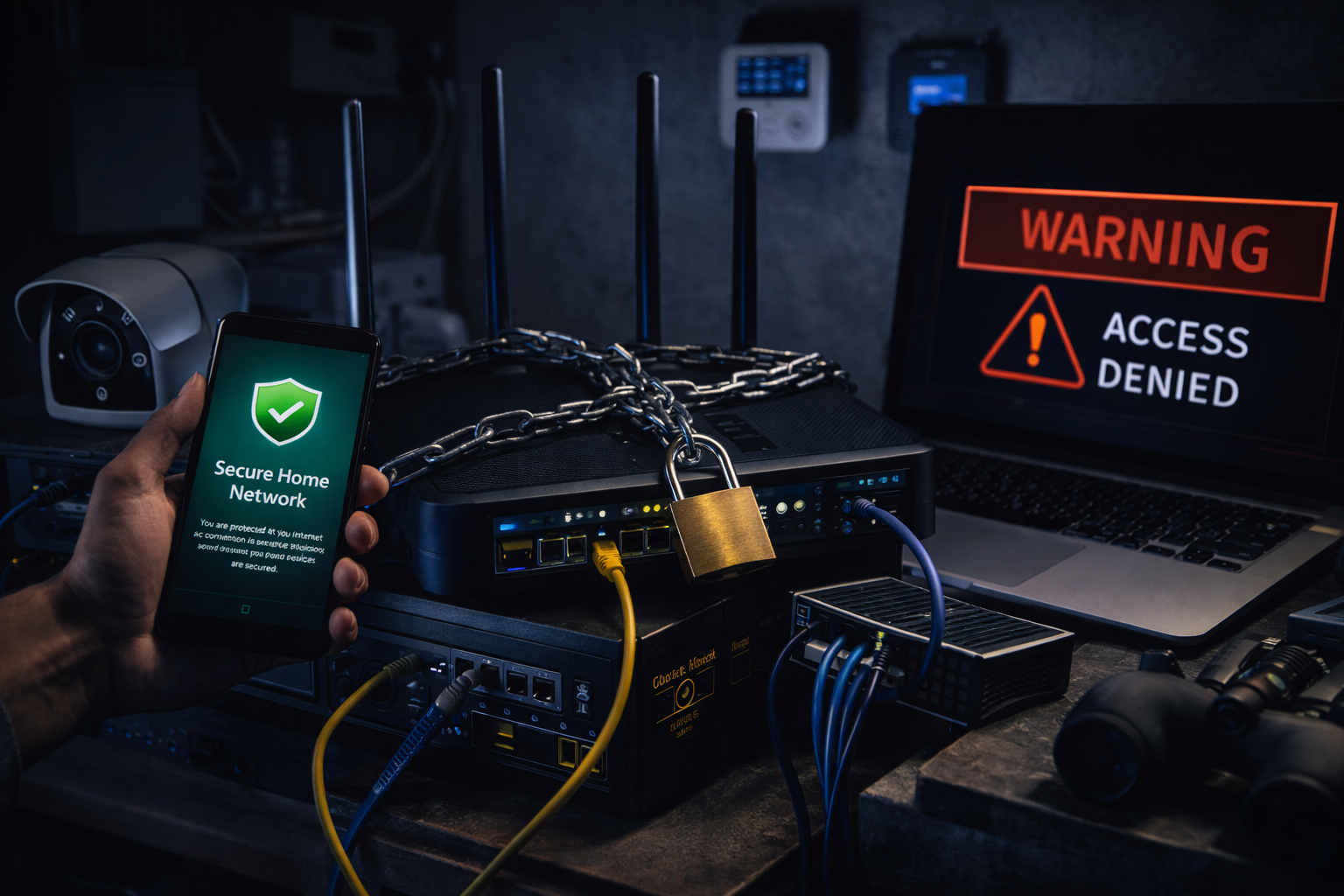
Cyber-Resilience is the critical digital layer of Domestic Systems Engineering that protects your home’s data and automation. In a hyper-connected world, your home network is no longer a luxury but a vital utility that controls your security and finances.
Most residential networks are configured with “Default Settings” that leave them wide open to external intrusion and exploitation. A compromised home network can lead to identity theft, financial loss, and the total failure of your physical security systems.
Domestic Systems Engineering requires a transition from a “Plug-and-Play” mentality to a “Hardened Infrastructure” model. This article details the engineering of a cyber-resilient home network designed to survive modern digital threats and social instability.
Learn how to build a digital fortress that secures your family’s privacy and ensures the continuity of your domestic operations. A resilient network is the silent guardian of your high-performance home, protecting every device connected to your private grid.
The Logic of the Digital Perimeter
The digital perimeter is the invisible boundary where your private domestic data meets the public, global internet. Just like a physical fence, this perimeter must be engineered to detect, delay, and defeat unauthorized access attempts.
In a resilient system, the router acts as the “Gatekeeper” that filters every incoming and outgoing packet of information. Most users ignore the router once it is installed, creating a massive vulnerability in the home’s primary digital defense.
Cyber-resilience starts with the realization that your digital assets are just as valuable as your physical possessions. Engineering this layer requires a disciplined approach to hardware selection, software updates, and user behavior.
Hardening the Gateway: Router Optimization
The router is the single most important piece of hardware in your home’s digital infrastructure. The first step in hardening your gateway is changing the default administrator credentials to a complex, unique password.
Disable “Remote Management” features that allow the router to be configured from outside your physical home. Enable the built-in “Firewall” and set it to the highest security level that still allows your essential services to function.
A hardened router is the foundation of a secure domestic environment, preventing intruders from even reaching your devices. Regularly audit your router’s logs to identify any suspicious connection attempts from unknown IP addresses.
The Power of Network Segmentation
Network segmentation is the practice of dividing your home Wi-Fi into separate “Zones” for different types of devices. In a high-performance home, you should never have your smart fridge on the same network as your banking computer.
Create a dedicated “IoT Network” for all smart devices, cameras, and appliances to keep them isolated from sensitive data. Use a separate “Guest Network” for visitors so they can access the internet without touching your private internal files.
This “VLAN” (Virtual Local Area Network) strategy ensures that if one smart lightbulb is hacked, the rest of the house remains secure. Segmentation is the digital equivalent of firedoors in a building, preventing a single breach from spreading.
Securing the Internet of Things (IoT)
The Internet of Things (IoT) represents the largest growing attack surface in the modern domestic landscape. Many smart devices are built with poor security protocols and rarely receive critical firmware updates from their manufacturers.
Before adding any new “Smart” device to your home, research its security track record and data privacy policies. Disable features like “Universal Plug and Play” (UPnP) which can automatically open ports in your firewall without your knowledge.
Treat every smart device as a potential “Trojan Horse” that could be used as a bridge into your private network. If a device does not absolutely need to be connected to the internet to function, keep it offline.
The Role of VPNs and Encrypted Tunnels
A Virtual Private Network (VPN) creates an encrypted tunnel for your data, making it unreadable to hackers or providers. Implementing a “Router-Level VPN” ensures that every device in your home is protected by default without individual setup.
This layer of encryption is vital when accessing sensitive work documents or performing high-value financial transactions. It hides your physical location and your browsing habits from the data-hungry algorithms of the modern web.
Encryption is the digital armor that protects your information as it travels through the hostile territory of the public internet. For a resilient home, privacy is not just a preference; it is a functional requirement for long-term security.
Password Hygiene and Multi-Factor Authentication
Human error and weak passwords remain the primary causes of successful cyber-attacks on domestic systems. A resilient home must implement a “Zero-Trust” policy regarding passwords and user access.
Use a dedicated “Password Manager” to generate and store unique, high-entropy passwords for every single account you own. Never reuse a password across different platforms, as a single breach can lead to a “Domino Effect” of account compromises.
Enable Multi-Factor Authentication (MFA) on every service that supports it, focusing on app-based or hardware-key solutions. MFA provides a redundant layer of security that stops an intruder even if they manage to steal your primary password.
Redundancy in Digital Communication
A cyber-resilient home must maintain the ability to communicate even when the primary internet service provider (ISP) fails. Integrate a “Dual-WAN” router that can automatically switch to a cellular 5G backup or satellite link during an outage.
This ensures that your security cameras, alarm systems, and remote work capability remain online during a crisis. Connectivity redundancy is the digital equivalent of having a backup generator for your electrical system.
In an increasingly volatile world, being “Offline” is a systemic risk that can prevent you from receiving life-saving information. Information flow must be protected with the same intensity as your water or power supply.
Protecting Data with Local Backups
Cloud storage is convenient, but it is a “Third-Party Dependency” that can be cut off or hacked at any time. A resilient home uses a “3-2-1 Backup Strategy” for all critical family photos, documents, and system configurations.
Keep three copies of your data, on two different types of media, with at least one copy stored off-site. Implement a “Network Attached Storage” (NAS) device in your home to act as your private, local cloud server.
Local backups ensure that you own your data and can access it even if the global internet infrastructure is disrupted. Data is the “Memory” of your domestic system; losing it is a catastrophic failure of engineering.
Physical Security of Digital Assets
The best firewall in the world is useless if an intruder can physically access your router or NAS device. Secure your primary networking hardware in a locked cabinet or a hidden “Server Closet” within your home.
Disable unused Ethernet ports in your walls to prevent someone from simply plugging into your network from a guest room. If you have exterior cameras, ensure the cables are shielded or buried so they cannot be easily cut or manipulated.
Physical access equals total control in the world of cybersecurity and domestic engineering. Protect the “Brain” of your network with the same physical vigor you use to protect your safe.
Firmware and Software Update Cycles
Software vulnerabilities are discovered daily, and “Patches” are the only way to close these digital gaps. Establish a monthly “Digital Maintenance Cycle” to check for updates on every device in your home infrastructure.
Automate updates whenever possible, but manually verify that your router and security cameras are running the latest versions. Operating an outdated system is like leaving your front door unlocked in a high-crime neighborhood.
Staying current with software is a low-effort, high-impact habit that prevents the majority of automated cyber-attacks. Discipline in maintenance is what separates a resilient system from a vulnerable one.
Detecting Intrusion with Monitoring Tools
You cannot defend against what you cannot see happening on your private network. Use “Intrusion Detection Systems” (IDS) or simple network monitoring apps to see which devices are active and how much data they use.
A sudden spike in outgoing data from a smart camera could indicate that it has been hijacked and is “Phoneing Home.” Being aware of the “Baseline” activity of your network allows you to spot anomalies before they become disasters.
Monitoring provides the “Situational Awareness” needed to make fast, effective decisions during a cyber-incident. Data-driven defense is the only way to keep up with the speed of modern digital threats.
Cyber-Resilience Training for the Family
The residents are the “Operators” of the digital system and represent the most common point of failure. Conduct “Phishing Awareness” training for everyone in the house to help them identify suspicious emails and links.
Establish a “Social Media Protocol” to prevent the sharing of location data or photos that reveal your home’s security layout. Cyber-security is a team sport that requires the active participation of every member of the household.
A single clicked link by a child or a guest can bypass thousands of dollars in hardware defenses. Education is the final, and most important, layer of your domestic cyber-resilience strategy.
Frequently Asked Questions
- Is a basic antivirus enough? No, antivirus only protects one device; you need network-level defense.
- Should I use a free VPN? Never; free VPNs often sell your data to third parties, which defeats the purpose.
- How often should I change passwords? Only when a breach is suspected, provided you use long, complex ones.
- Are Apple devices safer? They have good defaults, but they are not immune to network-level attacks.
The Structural Rule of Cyber-Resilience
If you do not control your home network, someone else eventually will. Engineer your digital perimeter today so your private life remains truly private tomorrow.

Adam Hulk is a professional barista, sensory analyst, and dedicated coffee educator with over a decade of experience in the specialty coffee industry. His journey began in the high-altitude farms of Colombia, where he spent a year studying the delicate relationship between volcanic soil and bean density.