
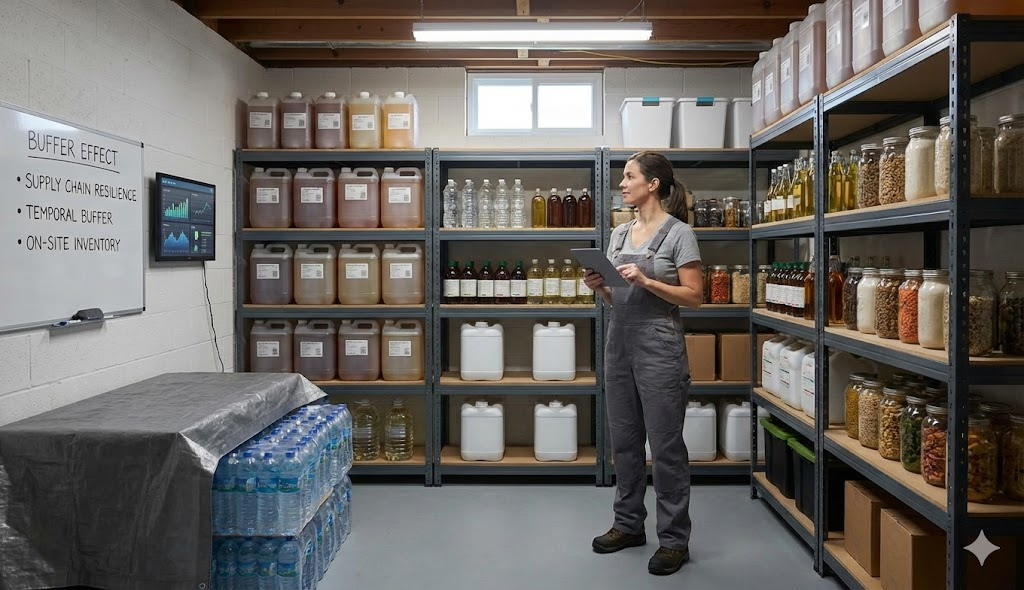
Bulk Acquisition is the strategic practice of purchasing household resources in large quantities to optimize cost and security. In the framework of Domestic Systems Engineering, buying in bulk is not just about saving money; it is about building a buffer.
Traditional retail shopping is a “Just-In-Time” (JIT) habit that relies on a perfectly functioning, fuel-dependent supply chain. A bulk acquisition model shifts your home from a vulnerable end-user to a resilient “Local Distribution Node.”
This article explores the financial and logistical engineering required to manage high-volume inventory effectively. Learn to calculate your storage costs versus your bulk savings to ensure every purchase adds systemic value.
Managing large volumes of goods requires a disciplined approach to space, rotation, and capital allocation. A high-performance home uses bulk buying to decouple its daily survival from the volatility of the global market.
The Financial Logic of Unit Price
The primary driver of bulk acquisition is the reduction of the “Unit Price” for every resource consumed. Manufacturers charge a premium for the convenience of small, individual packaging and frequent retail deliveries.
By purchasing a 20kg bag of rice instead of 1kg boxes, you drastically reduce the “Packaging Tax” and marketing costs. This “Logistics Arbitrage” allows you to secure the same caloric value for a fraction of the standard retail price.
Engineering your finances around bulk purchases requires looking at the “Cost per Use” rather than the initial price tag. Over a one-year cycle, these micro-savings accumulate into significant capital that can be reinvested into home infrastructure.
Calculating Storage Cost vs. Savings
Bulk buying is only efficient if the savings outweigh the “Carrying Cost” of the space required for storage. Every square meter of your home has a cost, and filling it with useless bulk items is a form of negative ROI.
Calculate the “Space Utility” by comparing the discount earned to the volume the product occupies in your storage zone. High-density items like oils, grains, and concentrated cleaners offer the best return on your storage investment.
Large, airy items like paper towels provide lower logistical efficiency compared to the space they demand. Focus your bulk strategy on “High-Density Assets” that provide the most utility per cubic centimeter of shelf space.
The Buffer Effect and Supply Chain Resilience
Bulk acquisition creates a “Temporal Buffer” that protects your household during local or global supply disruptions. If a logistics strike or a storm occurs, a bulk-managed home remains operational while others experience immediate scarcity.
This buffer allows you to wait for market prices to stabilize before you need to make your next replenishment purchase. You are no longer forced to buy at peak prices because your “On-Site Inventory” covers your immediate needs.
Resilience is the ability to absorb shocks without a change in your fundamental domestic performance. A deep inventory is the physical manifestation of that resilience within your home’s resource logistics.
The Infrastructure of Bulk Storage
You cannot implement a bulk logistics strategy without the proper “Storage Infrastructure” to protect your assets. Standard kitchen cabinets are rarely designed to handle the weight and volume of industrial-sized resource containers.
Install heavy-duty shelving units in cool, dry areas like basements, pantries, or climate-controlled garages. Use standardized, airtight bins to protect bulk dry goods from moisture, pests, and the degradation of oxygen.
Engineering your storage zones ensures that your bulk investment does not rot or become contaminated over time. Proper infrastructure is the “Hardware” that supports the “Software” of your high-volume acquisition plan.
Standardization of Consumables
To maximize bulk efficiency, you must “Standardize” the consumables used throughout your entire household system. Instead of five different types of surface cleaners, select one high-quality concentrate that can be bought in 20-liter pails.
Standardization reduces the complexity of your inventory and allows for more aggressive bulk pricing on single items. It also simplifies the training of household members on how to use and replenish the domestic supplies.
A lean inventory of standardized bulk goods is easier to manage, audit, and store than a fragmented collection of brands. Simplicity is a core engineering principle that leads to higher reliability and lower logistical friction.
Managing the Capital Outlay
Bulk acquisition requires a higher “Initial Capital Outlay” compared to buying single items on an as-needed basis. This requires a “Sinking Fund” or a dedicated portion of your monthly budget specifically for logistics replenishment.
View these purchases as “Inventory Investments” rather than “Monthly Expenses” to better track your financial performance. The capital is not “spent”; it is converted into a physical asset that resides on your shelves until it is used.
Strategic cash flow management ensures you can take advantage of deep discounts without straining your daily liquidity. Financial engineering is what provides the fuel for your high-volume domestic supply chain.
The “Case-Lot” Strategy for Perishables
While dry goods are easy to bulk buy, perishables require a “Case-Lot” strategy combined with preservation. Buying a full case of seasonal produce when it is at its price floor allows for massive savings.
To make this work, your home must have the “Processing Capacity” to freeze, dehydrate, or can the excess. Preservation turns a temporary bulk opportunity into a long-term nutritional asset for your pantry.
Integrating “Preservation” with “Acquisition” is the hallmark of a mature and efficient resource logistics system. It allows you to capture the energy of the seasons and store it for use during the more expensive winter months.
Avoiding the “Bulk Consumption” Trap
A common failure in bulk logistics is the “Consumption Trap,” where having more of an item leads to using it faster. Because the shelf is full of paper towels, residents may become less disciplined in how they use them.
Maintain strict “Usage Protocols” to ensure that the bulk savings are not lost to increased waste or inefficiency. Measure and dispense bulk items (like laundry detergent or oils) using standardized scoops or pump bottles.
Discipline in consumption is what turns a bulk purchase into an actual economic victory for the household. The system only works if the “Rate of Use” remains constant while the “Cost of Input” decreases.
Logistics of Transport and Delivery
Moving high-volume goods from the source to your home is a “Heavy-Lift” operation that requires its own planning. Consolidate your bulk shopping trips to once a quarter to minimize the fuel and time costs of transportation.
Consider professional delivery services for the heaviest items, such as water, pet food, or bulk grains. The “Last Mile” cost of getting goods into your storage room must be included in your total efficiency calculation.
Engineering the transport of your assets ensures that the physical labor of logistics does not become a deterrent. Efficiency in movement is just as important as efficiency in storage or procurement.
Frequently Asked Questions
- Will bulk food go bad? Only if it is not stored in airtight, moisture-proof, and dark containers.
- Is Costco the only way? No; restaurant supply stores and local wholesalers often offer better unit prices.
- How much should I buy? Start with a 3-month supply of your top 5 most-used non-perishable items.
- What if I move often? Keep your bulk inventory “Mobile” by using standardized, stackable totes with handles.
The Structural Rule of Bulk Acquisition
Never pay retail prices for items you know you will need six months from now. Engineer your procurement today so your capital works harder for your home’s future security.

Adam Hulk is a professional barista, sensory analyst, and dedicated coffee educator with over a decade of experience in the specialty coffee industry. His journey began in the high-altitude farms of Colombia, where he spent a year studying the delicate relationship between volcanic soil and bean density.