
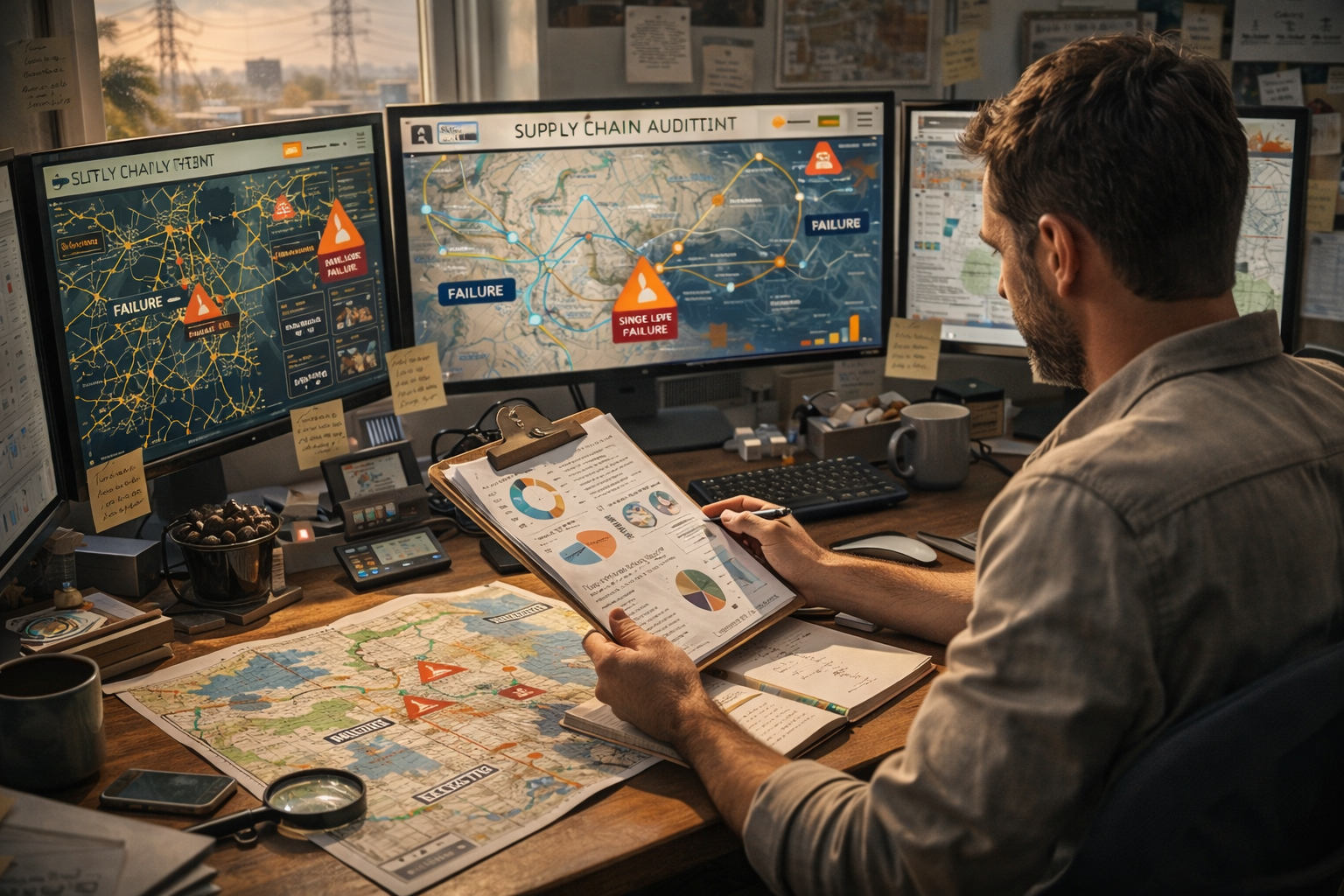
Supply Chain Auditing is the analytical process of mapping the origin and reliability of every resource that fuels your home. In a high-performance domestic system, you are not just a consumer; you are the lead auditor of your own life-support network.
Most households operate on a “Blind Trust” model, assuming that electricity, water, and food will always be available at the flick of a switch. Domestic Systems Engineering replaces this dangerous assumption with a “Vulnerability Map” that identifies exactly where your inputs are most likely to fail.
This article details how to perform a professional-grade audit of your home’s external dependencies and supply routes. Learn to identify “Single Points of Failure” in your procurement and develop strategies to bypass them before a crisis occurs.
A well-audited supply chain provides the “Strategic Foresight” needed to move from a reactive to a proactive defensive posture. Mastering these logistics ensures that your home remains functional even when the global “Just-In-Time” economy falters.
The Logic of Input Mapping
Input mapping is the structural exercise of tracing a resource from your point of use back to its primary source of origin. For every essential item, ask: “Where does this come from, and what infrastructures are required to bring it to my door?”
This process reveals the hidden “Interdependencies” between your home and the electrical grid, the fuel industry, and the trucking network. Understanding the path of your resources is the first step in identifying the external events that could threaten your domestic stability.
Mapping creates a visual and mental blueprint of your “Resource Geography,” allowing you to spot regional risks like droughts or strikes. Logistics auditing is a matter of “Situational Awareness,” ensuring you are never surprised by a foreseeable interruption in supply.
Identifying Single Points of Failure
A “Single Point of Failure” (SPOF) is a unique component in a system that, if it fails, brings the entire operation to a halt. In a home, the municipal water main or the primary electrical transformer for your neighborhood are classic examples of SPOFs.
The goal of a supply chain audit is to identify every SPOF in your household and engineer a “Redundant Bypass” for each. If you only have one source of heat and it requires a specific gas line, that gas line is a critical vulnerability.
By identifying these points, you can prioritize your investments in backup generators, water tanks, or multi-fuel heating stoves. Eliminating SPOFs is the primary engineering goal for achieving absolute domestic resilience and operational continuity.
The “Distance-to-Source” Risk Factor
The physical distance between your home and the source of a resource is a direct multiplier of your logistical risk. A supply chain that spans across continents is far more vulnerable to disruption than one that is contained within your local county.
During an audit, categorize your inputs into “Local,” “Regional,” and “Global” tiers to assess their relative stability. Food that travels 2,000 miles is highly sensitive to fuel prices and interstate logistics, while food from a local farm is not.
Engineering your supply chain to favor “Local Inputs” reduces the number of failure points between the source and your table. Shortening the distance is the most effective way to improve the “Response Time” and reliability of your domestic logistics.
Auditing the Energy Supply Chain
Energy is the “Primary Input” that enables all other domestic systems, from water filtration to climate control. Audit your energy supply by identifying the mix of fuels used by your local utility and their storage capacity for those fuels.
If your grid relies on “Natural Gas” delivered via a single pipeline, your electricity is vulnerable to any disruption in that pipe. Assess the reliability of the “Last Mile” infrastructure, such as the age of the poles and wires leading to your specific property.
This audit informs your decision on how much “On-Site Storage” (batteries or fuel) you need to bridge a localized grid failure. Energy logistics is a matter of “Temporal Security,” buying you the time needed for the primary supply to be restored.
Food Supply Chain and Seasonal Gaps
The food supply chain audit involves analyzing the “Retail Availability” of your core staples during different times of the year. Identify which items are imported from politically or environmentally unstable regions and find local or stored alternatives.
Recognize the “Seasonal Gaps” in your local food production where fresh inputs may become expensive or completely unavailable. Your “Long-Term Pantry” should be designed specifically to fill these gaps and act as a buffer against global price volatility.
Understanding the “Wholesale Flow” of food in your area helps you predict which items will vanish first during a panic-buying event. Information is the “Early Warning System” that allows you to top off your reserves before the retail shelves are empty.
Water Source and Treatment Vulnerability
Audit your water supply by investigating the “Upstream” conditions of your municipal reservoir or your private well’s aquifer. Identify potential sources of contamination, such as industrial zones or agricultural runoff, that could affect your water quality.
Assess the “Pumping Logistics” of your city; does the water tower rely on an electrical grid that lacks a backup generator? If the city pumps stop, your high-elevation faucets will lose pressure almost immediately regardless of the water volume in the reservoir.
This audit dictates the size of your “On-Site Water Buffer” and the complexity of the filtration hardware you must maintain. Water security is a matter of “Flow Control,” ensuring that you can maintain a clean supply even when the external pumps fail.
The “Logistics of the Road”: Accessibility
A supply chain audit must include the “Physical Accessibility” of your home to delivery trucks and emergency services. Identify “Choke Points” such as bridges, narrow tunnels, or flood-prone roads that could isolate your property from external help.
If your primary supply route is blocked, do you have a secondary “Backdoor” route for receiving resources or evacuating? Assess the “Last-Mile Delivery” capability of your local couriers and their resilience during severe weather or fuel shortages.
Physical logistics is a matter of “Terrain Awareness,” ensuring that your home does not become an isolated island during a crisis. The best supply chain in the world is useless if the final 100 meters to your door are impassable.
Auditing Digital and Communication Links
In the modern home, “Information” is a critical input that requires its own supply chain audit for reliability and speed. Identify the “Physical Path” of your fiber-optic or copper lines and locate the nearest “Central Office” or “Node” for your ISP.
Assess the vulnerability of these lines to physical damage from construction, storms, or vandalism in your immediate neighborhood. Audit your “Cellular Coverage” to identify which carrier provides the best signal during a high-traffic or emergency event.
Digital auditing ensures that your “Command and Control” center remains connected to the outside world when it matters most. Redundancy in communication is the “Digital Life-Line” that allows you to manage all other domestic logistical challenges.
The Financial Supply Chain: Liquidity Flow
Your ability to acquire resources is ultimately dependent on your “Financial Supply Chain” and your access to liquid capital. Audit your “Cash Flow” and identify how many “Hurdles” exist between your savings and your ability to purchase emergency goods.
If the banking network or ATMs go offline, do you have “On-Site Cash” to facilitate local trades and essential purchases? Assess the stability of your primary income sources and develop a “Financial Buffer” that covers at least six months of logistics.
Financial logistics is the “Universal Solvent” that can fix many other supply chain failures through the acquisition of new assets. Maintaining a liquid reserve is the final and most flexible layer of your home’s total resource resilience.
Frequently Asked Questions
- How often should I audit? Perform a “High-Level Audit” annually or after any major change in your local infrastructure.
- Is a 100% independent home possible? It is extremely difficult and expensive; aim for 90% resilience for most scenarios.
- What is the biggest risk? For most modern homes, a prolonged failure of the electrical grid is the primary systemic threat.
- How do I find utility data? Most utility companies provide “Reliability Reports” and infrastructure maps on their websites.
The Structural Rule of Supply Chain Auditing
If you do not know the path your resources take, you are at the mercy of every break in the chain. Audit your inputs today so you can engineer the redundancies that will keep your home functional tomorrow.

Adam Hulk is a professional barista, sensory analyst, and dedicated coffee educator with over a decade of experience in the specialty coffee industry. His journey began in the high-altitude farms of Colombia, where he spent a year studying the delicate relationship between volcanic soil and bean density.