
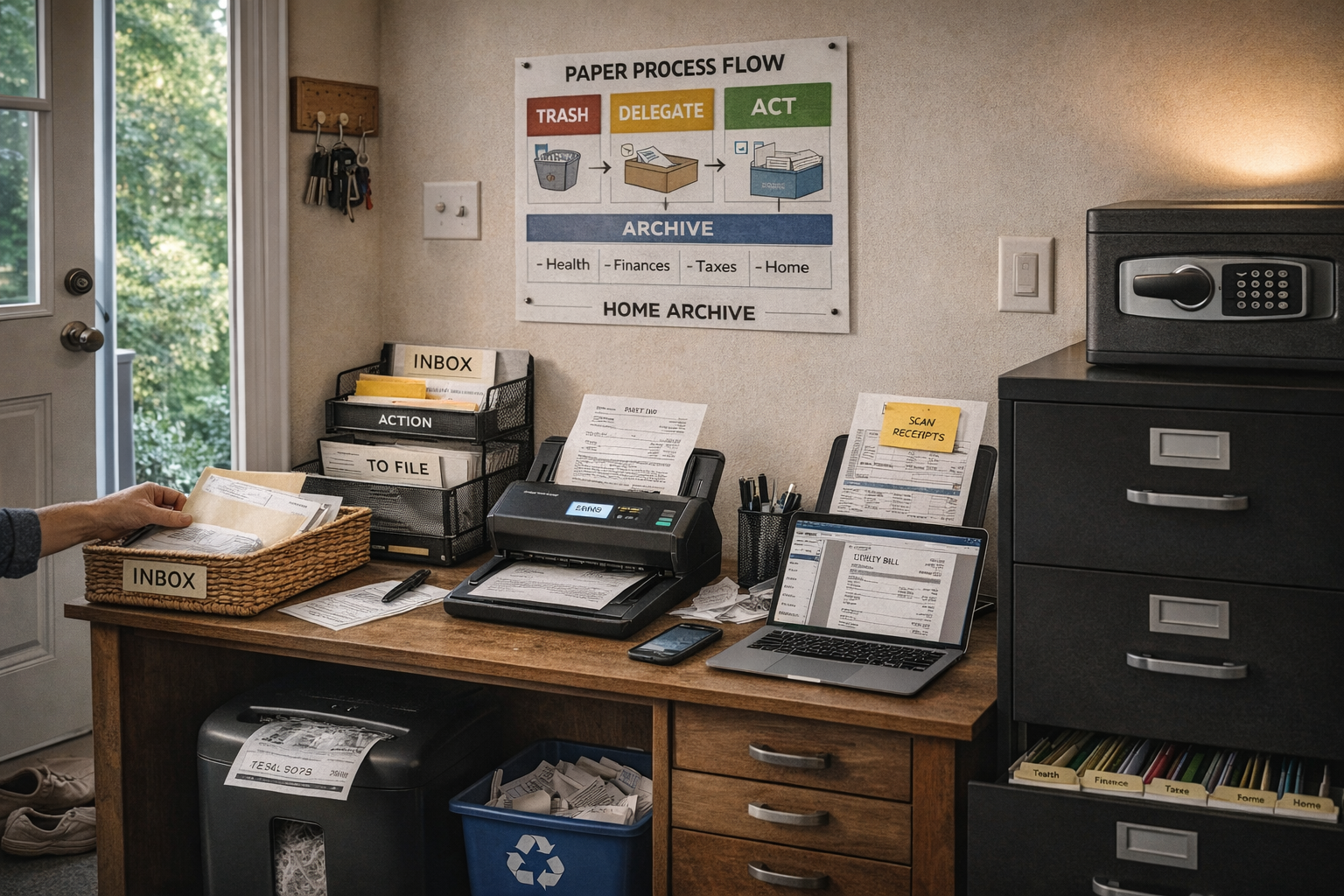
The Zero-Inbox Philosophy applied to physical paperwork is the only architectural solution to prevent domestic bureaucracy from overwhelming a home’s efficiency.
Most households treat mail and documents as static debris that accumulates on flat surfaces.
Piles of paper are, in fact, deferred decisions that drain both visual and cognitive energy from the residents.
A high-performance home system requires that every single sheet of paper has an immediate and logical destination.
Paper must never “live” on a table or a kitchen counter; it must be in motion or in a permanent archive.
This article details the architecture of a paper processing system that eliminates clutter and ensures information security.
Transforming physical chaos into a digital flow is the ultimate goal of this household archive protocol.
Why Paper Is the Primary Enemy of Visual Order
Paper is light, cheap, and easy to ignore individually, but it is lethal in mass.
A single letter does not seem like a problem, but ten letters create a significant visual friction point.
The human brain processes clutter as a persistent list of unfinished tasks.
Every pile of paper sends a constant signal that something is pending, forgotten, or neglected.
Eliminating physical paper is therefore an act of mental hygiene and architectural preservation.
The clarity of your home’s surfaces directly reflects the clarity of your internal household processes.
The Fundamental Difference Between Storing and Archiving
Storing is placing an item in a location without a retrieval plan; it is creating a data cemetery.
Archiving is placing an item in a system where retrieval is guaranteed, fast, and logical.
Most people store paper in random drawers when they should be archiving it or destroying it.
A functional archive requires a logical structure that any resident in the home can navigate.
If it takes more than sixty seconds to find a specific document, your system has structurally failed.
The utility of any document is directly proportional to the speed of its accessibility.
The Protocol of the “Landing Strip” for Incoming Mail
Paper management begins the exact second it crosses the threshold of your front door.
There must be a designated “landing strip” for all incoming mail and physical documents.
This area must be equipped with the primary processing tools: a letter opener, a recycling bin, and a shredder.
Never take the mail to the sofa, the bed, or the dining table; process it standing up at the entry zone.
The goal is for 80% of incoming paper to be discarded within the first two minutes of entry.
Immediate sorting prevents the formation of secondary piles throughout the living space.
The Four Actions of the Paper Processing Loop
Faced with any physical document, there are only four possible logical actions: Trash, Delegate, Act, or Archive.
Trash (recycle or shred) anything that does not have immediate legal, fiscal, or functional value.
Delegate if the matter belongs to another family member or an external service provider.
Act is for bills to be paid or forms to be filled (ideally handled during the “Administrative Batch”).
Archive is reserved for the 5% of documents that require long-term physical retention by law.
Hesitation between these four actions is what creates systemic disorder and clutter.
Why You Must Shred Instead of Just Recycling
Information security is a critical component of high-level home management.
Documents with names, addresses, or account numbers are active vectors for identity theft.
A cross-cut shredder should be a central piece of your home’s paper infrastructure.
The act of shredding is the definitive closure of an information cycle.
Do not let sensitive papers sit in a pile waiting to be destroyed; do it at the moment of sorting.
Immediate destruction is a proactive security habit that prevents future vulnerabilities.
The Logic of Digitization: Ending the “Dead File” Era
Modern technology allows almost all paper to be transformed into searchable, weightless data.
Invest in a high-speed document scanner or use high-quality mobile scanning applications.
Once scanned and saved to a secured cloud service with redundant backups, the original paper loses its function.
A digital archive occupies zero physical space and can be searched via keywords in seconds.
The transition from physical to digital is the single greatest evolution in domestic efficiency.
The “Cloud Archive” is the logical successor to the heavy, metallic filing cabinet.
How to Structure a Digital Archive for Instant Retrieval
Digitization is useless without a logical and consistent naming convention for files.
Use a standard format like “YYYY-MM-DD_Document_Name” for every single file.
Create main folders for Health, Finances, Home, Vehicles, Taxes, and Identity.
Consistency in naming eliminates the need to open ten files to find the correct one.
The digital structure should mirror the mental structure of your responsibilities.
A well-named archive is a powerful asset; a poorly named one is just digital noise.
The Role of the “Administrative Batch” in Document Management
Not every piece of paper can be resolved at the moment of initial entry or sorting.
Complex bills or contracts that require deep reading should be placed in a dedicated “Action Pending” folder.
This folder is processed in its entirety during your weekly “Administrative Batching” session.
This prevents administrative tasks from interrupting the creative or social flow of your day.
Grouping bureaucracy reduces the mental resistance often associated with tedious tasks.
The system protects your free time by confining bureaucracy to a specific, controlled block.
Why Sales Receipts Are a Systemic Trap
Grocery receipts and small purchase slips accumulate rapidly in wallets and on counters.
Most have no utility once the bank statement has been reconciled online.
Digitize only receipts for items with active warranties or for specific tax deduction purposes.
Shred the rest immediately to prevent the “micro-paper pollution” of your living space.
Receipt management is a daily battle against small-scale waste.
Maintain your wallet as a strict “zero-paper” zone.
Managing Vital Documents: The Fire-Safe Archive
Birth certificates, deeds, and original insurance policies require specialized physical protection.
This 1% of documents must be stored in a fireproof and waterproof safe.
This is the “Heart of the Archive,” the last stand of physical paper within the home system.
Even these vital documents must have digital copies accessible remotely in case of an emergency.
The physical protection of vital assets is a responsibility of family continuity.
Know exactly where these documents are located in the event of a rapid evacuation.
Handling “Paper Nostalgia” (Letters and Children’s Art)
Birthday cards, invitations, and children’s drawings carry an emotional load that is difficult to discard.
Do not mix these items with functional paper like bills, taxes, or manuals.
Create a dedicated “Memory Box” with limited physical dimensions for each family member.
When the box is full, something must leave for something new to enter (the “One In, One Out” rule).
Digitizing children’s art is an excellent way to preserve the memory without cluttering the shelves.
Emotional curation prevents affection from turning into systemic hoarding.
Eliminating Subscriptions and Unwanted Physical Mail
The most effective way to manage paper is to stop it from ever reaching your mailbox.
Cancel subscriptions to magazines you no longer read and register for “do-not-mail” lists.
Always opt for paperless billing and electronic statements for every service you use.
Every digital subscription is a piece of physical paper you will never have to process.
Reduction at the source is the highest level of systemic management.
Attack the cause of the clutter, not just the symptom of the pile.
Why You Should Create a Physical and Digital “Home Manual”
Despite the Zero-Inbox philosophy, a physical home operations manual is extremely useful.
This manual should contain Wi-Fi codes, emergency contacts, and basic maintenance instructions.
It can be a slim binder or a shared document in the cloud.
It serves as the “Single Source of Truth” for all residents, guests, and house-sitters.
Centralizing information reduces the need for repetitive questions and frantic searches.
Documentation is the operational memory of your Home System.
The Impact of Paper Clutter on Mental Health and Stress
Living in an environment filled with piles of paper significantly increases cortisol levels.
Physical paper acts as a constant visual reminder of obligations and unresolved history.
Clearing paper from horizontal surfaces produces an immediate and profound psychological relief.
Documentary minimalism allows the brain to relax and focus on the present moment.
Peace of mind is a direct benefit of a robust and automated filing system.
External order facilitates internal order.
Maintaining the System: The Weekly Paper Reset
Even with a high-quality system, small amounts of paper can “leak” into the wrong places.
Dedicate ten minutes at the end of the week for a “Paper Hunt” throughout the house.
Check coat pockets, bags, and obscure horizontal surfaces for stray documents.
Place everything you find back into the initial sorting and processing protocol.
Preventative maintenance stops the long-term collapse of the organizational structure.
Rigorous adherence is what separates a functional system from a mere good intention.
Teaching the Paper Logic to Other Residents
A personal filing system in a shared household is destined for systemic failure.
All residents must be aware of the sorting, recycling, and shredding zones.
Explain the logic of “don’t put it down, put it away” to everyone in the home.
If everyone respects the Landing Strip, the house remains clear without excessive individual effort.
Systemic education is an investment in collective harmony and reduced friction.
Responsibility for the paper flow must be a shared household value.
The Hidden Financial Cost of Paper Disorganization
Lost bills result in late fees, interest charges, and damaged credit scores.
Misplaced warranties lead to repair costs that could have been covered for free.
Unclaimed tax benefits due to lost receipts are simply money thrown away.
An efficient paper management system pays for itself through direct financial savings.
Organization is a primary tool for capital retention.
Your archive is essentially your personal accounting department.
Why the Scanner Is the Most Underrated Tool for Freedom
Transitioning to a paperless home frees up square footage and mental bandwidth.
The scanner is the portal that converts physical weight into digital lightness.
Use OCR (Optical Character Recognition) to make your PDFs fully searchable.
This means you can find your insurance policy in seconds just by typing “Insurance.”
Technology should be used to remove the friction of bureaucratic existence.
Freedom is not having to carry your past in cardboard boxes.
Frequently Asked Questions about the Zero-Inbox Paper Philosophy
- Should I keep paid bills? Only for major assets (car, house) or tax-deductible items; scan the rest.
- How long should I keep tax documents? Generally seven to ten years, depending on local laws.
- What about appliance manuals? Almost all are available as PDFs online; recycle the physical versions.
- What if the digital system fails? Use dual backups (external hard drive and cloud) for total redundancy.
The Structural Rule of Paper Management
If a piece of paper does not serve a legal, financial, or deep sentimental purpose, it is waste.
Do not allow waste to masquerade as “important documentation” in your drawers.
Process immediately, archive logically, and liberate yourself physically.

Adam Hulk is a professional barista, sensory analyst, and dedicated coffee educator with over a decade of experience in the specialty coffee industry. His journey began in the high-altitude farms of Colombia, where he spent a year studying the delicate relationship between volcanic soil and bean density.