
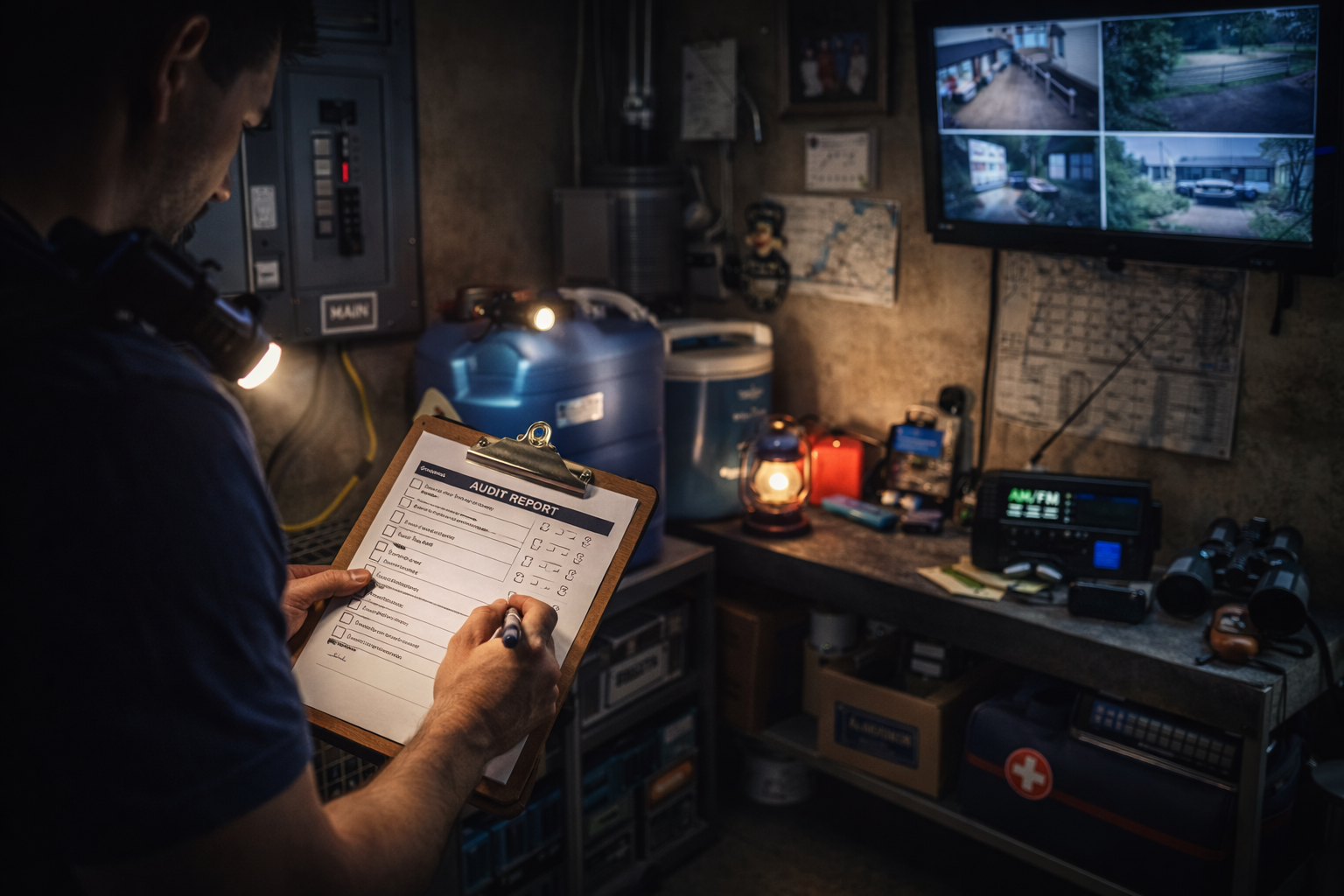
The Resilience Audit is the final and most critical phase of Domestic Systems Engineering. It is the process of deliberately testing your infrastructure to identify hidden weaknesses before a real crisis occurs.
Most people build emergency systems and assume they will function perfectly when the time comes. However, mechanical parts seize, batteries degrade, and human memory fails under the pressure of adrenaline.
A high-performance home requires a “Red Teaming” approach where you simulate system failures. This article details how to perform a comprehensive stress test on your power, water, and security layers.
Learn how to audit your domestic readiness to ensure that your “Paper Plan” translates into “Real-World Performance.” A system that has not been tested is not a system; it is merely a collection of expensive hopes and assumptions.
The Philosophy of the Controlled Failure
A controlled failure is a planned event where you intentionally disable a primary utility to observe the result. By turning off your main water valve on a Saturday morning, you force the “Backup System” to activate in a safe environment.
This practice reveals exactly how long it takes to switch to “Island Mode” and what tools are missing. It is better to discover a broken pump or a missing wrench during a drill than during a Category 5 hurricane.
Stress-testing creates “Muscle Memory” for the residents, reducing panic and error during a genuine emergency. Failure in a simulation is a success in engineering, as it provides the data needed to fix the flaw.
Auditing the Energy Infrastructure
The energy audit begins by cutting the main breaker to the entire house for a period of four to six hours. Observe which “Critical Loads” remain powered by your UPS or battery backup systems and which ones fail immediately.
Monitor the discharge rate of your batteries to see if they meet the theoretical runtime you calculated. Test your solar charging capacity during this window to ensure the panels are providing the expected wattage.
If your backup power fails to keep the refrigerator or the internet router running, your system is under-dimensioned. This data allows you to precisely upgrade your battery bank or reduce your baseline energy consumption.
Water System Integrity Testing
To audit your water security, shut off the municipal supply and rely exclusively on your stored reserves for 24 hours. Track exactly how much water each family member consumes for drinking, cooking, and sanitation tasks.
Test your manual pump or gravity-fed lines to ensure there are no air locks or leaks in the redundant plumbing. Perform a “Purification Drill” where you filter and treat a gallon of water using only your emergency tools.
Most people underestimate their actual water usage and find that their 72-hour reserve only lasts 48 hours. The audit provides the “Hard Data” needed to adjust your storage volume to meet the reality of your household.
The “Safe Room” Thermal Stress Test
Thermal audits should be performed during the peak of summer or the depth of winter to be truly effective. Turn off the HVAC system and move the household into the designated “Safe Room” for a four-hour period.
Measure the temperature drop (or rise) over time to evaluate the effectiveness of your insulation and sealants. Deploy your emergency heating or cooling tools to see how quickly they can stabilize the micro-climate.
This test identifies “Thermal Leaks” around doors and windows that you might have missed during a visual inspection. It also helps residents understand the physical and psychological reality of living in a confined, temperature-controlled space.
Testing the Communication Redundancy
A communication audit involves disabling your primary home Wi-Fi and the data plans on all primary smartphones. Attempt to gather emergency information using only your AM/FM radio or your secondary satellite/cellular backup.
Verify that your “Emergency Contact List” is physically printed and that all numbers are still current and functional. Check the signal strength of your backup radio in different parts of the house to find the “Communication Sweet Spot.”
In a crisis, the loss of information causes more chaos than the loss of power; you must verify your links. A redundant link that has never been tested is a link that will likely fail when the towers go dark.
Security Breach and Perimeter Drill
The security audit requires a “walk-through” of your perimeter defense layers from the perspective of an intruder. Check every window and door for “Play” in the frames or locks that could be exploited with simple hand tools.
Test your motion-activated lighting at night to ensure there are no blind spots where someone could approach undetected. Execute a “Safe Room Drill” where every family member must reach the internal bunker and secure the door in under 60 seconds.
This drill reveals if children or elderly residents can operate the locks or if the path is obstructed by clutter. Security is a functional flow that must be optimized for speed and simplicity under high stress.
The Medical Inventory and Skill Audit
A medical audit involves a complete physical inventory of every item in your trauma station and first aid kits. Check for expired medications, dried-out antiseptic wipes, and degraded adhesive on bandages or chest seals.
Perform a “Skill Check” where each resident must demonstrate the correct application of a tourniquet or a pressure bandage. If someone hesitates or makes a mistake, it indicates that more training is required for that specific operator.
Hardware is secondary to the “Firmware” of human knowledge; skills must be refreshed every six months to remain sharp. An audit ensures that your medical response infrastructure is both physically and intellectually ready.
Food System and Cooking Readiness
To test your food resilience, prepare a full day of meals using only the items found in your “Deep Pantry.” Use your emergency cooking stove to boil water and cook staples like rice or beans to test fuel consumption.
Check the seals on your bulk storage bins for signs of pests or moisture that could compromise your long-term assets. This “Pantry Challenge” helps identify which foods are difficult to prepare or which seasonings are missing from your stock.
It also verifies that your manual can opener works and that your cookware is compatible with your emergency heat sources. Eating your “Resilience Food” once in a while ensures that the system is practical and palatable.
Logistics and Evacuation Audit
Sometimes the most resilient choice is to leave; therefore, you must audit your “Go-Bags” and evacuation routes. Load your 72-hour kits into the vehicle and verify that the fuel level and tire pressure are within safety limits.
Review your primary and secondary evacuation maps to identify potential “Choke Points” like bridges or narrow tunnels. Ensure that all vital documents (passports, titles, insurance) are gathered in a single “Grab-and-Go” folder.
The ability to mobilize the entire household in under ten minutes is a hallmark of a high-performance domestic system. Evacuation is a complex logistical operation that requires a high level of coordination and prior testing.
Documenting the “Audit Report”
After every stress test, write down a “Post-Action Report” detailing what worked and what failed miserably. Assign a “Priority Level” to each failure and create a timeline for repairing or upgrading that specific component.
This documentation creates a historical record of your home’s evolution toward total resilience and safety. It also provides a clear “To-Do List” for your future Domestic Systems Engineering projects and investments.
A professional audit turns a weekend of “Playing Survival” into a serious engineering project with measurable outcomes. Transparency about your system’s flaws is the only way to build a structure that is truly failure-proof.
The Frequency of the Resilience Audit
Resilience is not a destination; it is a “Current State” that must be maintained through regular intervention. Perform a “Mini-Audit” of one system every month and a “Full-Scale Audit” of the entire home once per year.
As your home infrastructure changes and new technology is added, new vulnerabilities will inevitably emerge. The audit keeps you ahead of the curve, ensuring that your security grows alongside your lifestyle.
Regular testing transforms “Emergency Readiness” from a source of anxiety into a source of confidence and pride. You are no longer hoping for the best; you are prepared for the worst because you have already seen it happen.
Frequently Asked Questions
- Will these tests damage my home? Not if performed carefully; they are designed to be “Controlled Failures.”
- What if my family resists the drills? Frame them as a “System Challenge” or a fun way to learn new skills.
- Should I test everything at once? No, start with one system at a time to prevent overwhelming the residents.
- Is professional auditing available? Some security and energy firms offer audits, but DIY is more educational.
The Structural Rule of the Resilience Audit
A system that has not been tested to the point of failure is a system you cannot trust with your life. Find the cracks in your domestic fortress today so you can stand strong when the world begins to shake.

Adam Hulk is a professional barista, sensory analyst, and dedicated coffee educator with over a decade of experience in the specialty coffee industry. His journey began in the high-altitude farms of Colombia, where he spent a year studying the delicate relationship between volcanic soil and bean density.