
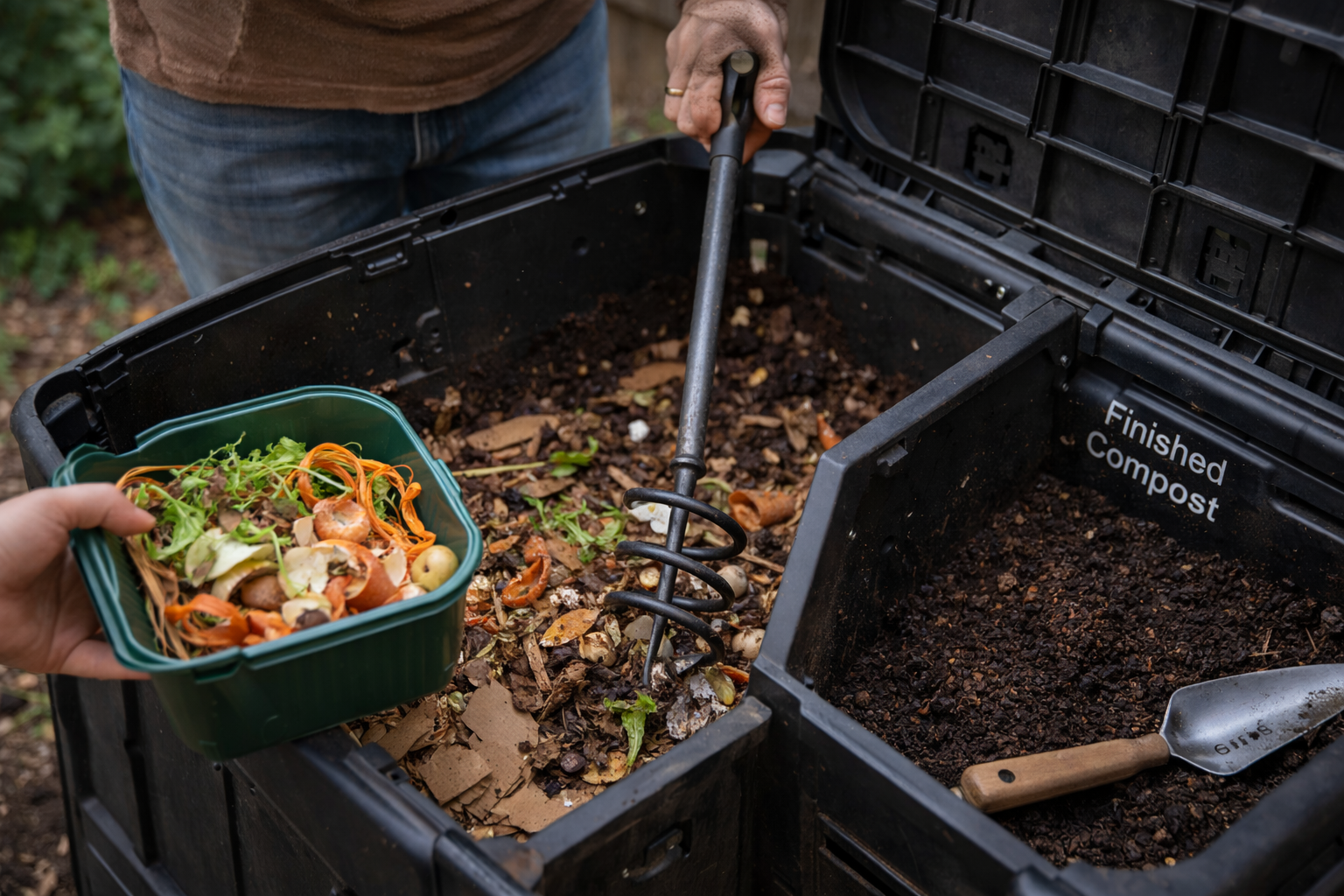
Home composting is often treated as a hobby. It should be treated as a biological process. Most people start with excitement and end with a pile of rot. The failure is not in the biology; it is in the architecture of the system. Composting requires a balance of inputs, oxygen, and management. If any part of the logic is missing, the system collapses. This article explains the structural reasons for compost failure and how to build a resilient one.
Why Excitement Is the Worst Starting Point
Excitement is temporary. Biology is persistent. When excitement fades, the pile is neglected. Build for your laziest day, not your most motivated one.
The Carbon-Nitrogen Logic Gap
Most people add too much “green” (nitrogen). Nitrogen without carbon creates smell and slime. Carbon is the skeletal structure of compost. Without a skeleton, the system smothers itself.
Why Oxygen Is a Design Choice
Oxygen does not happen by accident in a pile. It must be designed into the structure. Turners, aerators, or porous walls are requirements. An anaerobic system is a failed system.
The Problem with “Hidden” Compost Bins
Out of sight, out of mind. If the compost is too far away, it becomes a burden. If it is too hidden, you forget to monitor it. Strategic visibility ensures maintenance.
Why Moisture Is Often Mismanaged
Too wet and it rots. Too dry and it stops. The “wrung-out sponge” rule is a logic check. Systemic moisture control prevents biological stalls.
The Role of Particle Size in Decomposition
Big chunks take forever. Small chunks disappear fast. Surface area is the engine of decay. Manage the input size to control the output speed.
Why Most Bins Are the Wrong Size
Too small and they can’t hold heat. Too large and they are impossible to turn. Scale must match your output and your physical ability. Size is a functional constraint.
The Myth of “No-Maintenance” Composting
Everything requires energy. No-maintenance usually means slow and smelly. Accept the “work” and design it to be 5 minutes a week. Minimal maintenance is a better goal than zero.
Why Seasonal Changes Kill Amateur Systems
Winter freezes biology. Summer dries it out. A resilient system has a “weather strategy.” Insulation and shade are structural components.
Avoiding the “Kitchen to Pile” Friction
If the kitchen container is gross, you won’t use it. The interface between the house and the garden must be clean. Design the transfer to be painless. Friction at the start kills the end.
The Importance of a “Browns” Reservoir
You always have greens (scraps). You rarely have browns (leaves/cardboard) when you need them. A system without a dedicated carbon storage is destined to fail. Store the carbon before you need it.
Why You Should Stop Composting Everything
Some things are technically compostable but systematically difficult. Meat, dairy, and heavy oils invite pests. Pests create system stress. Start with the “easy” wins to build the habit.
The Role of Pests as System Feedback
Flies and rodents are not just nuisances. They are indicators of a logic error. Too much exposed food? Too much moisture? Listen to the pests to fix the bin.
Why Turning the Pile Is a Chemical Necessity
Turning redistributes heat and bacteria. It prevents “dead zones” in the bin. If turning is hard, your bin design is wrong. Mechanical ease is a requirement.
The Difference Between Cold and Hot Composting
Cold is easy but slow. Hot is fast but demanding. Choose the logic that fits your lifestyle. Don’t aim for “hot” if you won’t do the work.
Managing the “Ugly” Factor
Compost doesn’t have to be an eyesore. An ugly system creates social friction in the home. Aesthetics matter for long-term adoption. Integration beats isolation.
Why Cardboard Is the Secret Weapon
Cardboard is free, abundant carbon. It absorbs excess moisture. It provides structure for air pockets. Always have a shredder nearby.
The Danger of Chemical Contamination
Treated wood or pesticide-heavy grass kills the biology. The system is only as clean as its inputs. Rigidly filter what enters the cycle. Contamination is irreversible.
Why Every System Needs a “Done” Zone
Mixing old and new compost creates confusion. You need a clear exit for finished material. A two or three-bin system provides chronological logic. Flow requires a beginning and an end.
The Impact of Soil Microbes on Human Health
Composting connects you to the earth’s microbiome. It is a health-building activity. The system serves the garden, which serves you. The loop is personal.
Why Success Is Measured in “Crumbly Gold”
The output should be earthy and rich. If it looks like dirt, you won. If it looks like food, you are still in process. Wait for the logic to finish its work.
Using Compost as a Feedback Loop for Food Waste
The pile tells you what you aren’t eating. Seeing whole vegetables in the compost is a wake-up call. The compost system audits your grocery habits. Waste at the end signals error at the start.
The Role of Temperature Gauges
You can’t manage what you don’t measure. A simple thermometer tells you if the biology is awake. Data removes the guesswork. Logic thrives on data.
Dealing with Neighbors and Smell
A smelly bin is a social failure. Proper carbon management eliminates odor. Your system should be a “good neighbor.” Silence (and lack of smell) is a sign of quality.
Why Worms (Vermicomposting) Are a Different Logic
Worms are livestock. They require a different architectural approach. Don’t mix the two logics until you are an expert. Simplicity is the first rule of success.
Teaching the “Pile Logic” to Others
Explain that it is alive. It’s not a trash can; it’s an organ. People respect life more than garbage. Change the perception to change the behavior.
Why This Habit Is the Ultimate Sustainability Gate
Composting closes the most important loop in a home. It turns a “cost” into an “asset.” Once you master this, you master the home. It is the foundation of a circular life.
The Long-Term ROI of Home Soil
Buying soil is expensive and plastic-heavy. Making soil is free and carbon-sequestering. The dividends grow every season. Invest in your own dirt.
Frequently Asked Questions
- Does it smell? Only if the logic (oxygen/carbon) is broken.
- Can I do this in an apartment? Yes, using Bokashi or worm bins.
- How long does it take? 3 to 9 months depending on management.
- What about winter? The system sleeps; keep adding browns.
The Structural Rule of Composting
If your compost pile feels like a chore, you haven’t built a system; you’ve built a burden. Biology works for free—let it.

Adam Hulk is a professional barista, sensory analyst, and dedicated coffee educator with over a decade of experience in the specialty coffee industry. His journey began in the high-altitude farms of Colombia, where he spent a year studying the delicate relationship between volcanic soil and bean density.