
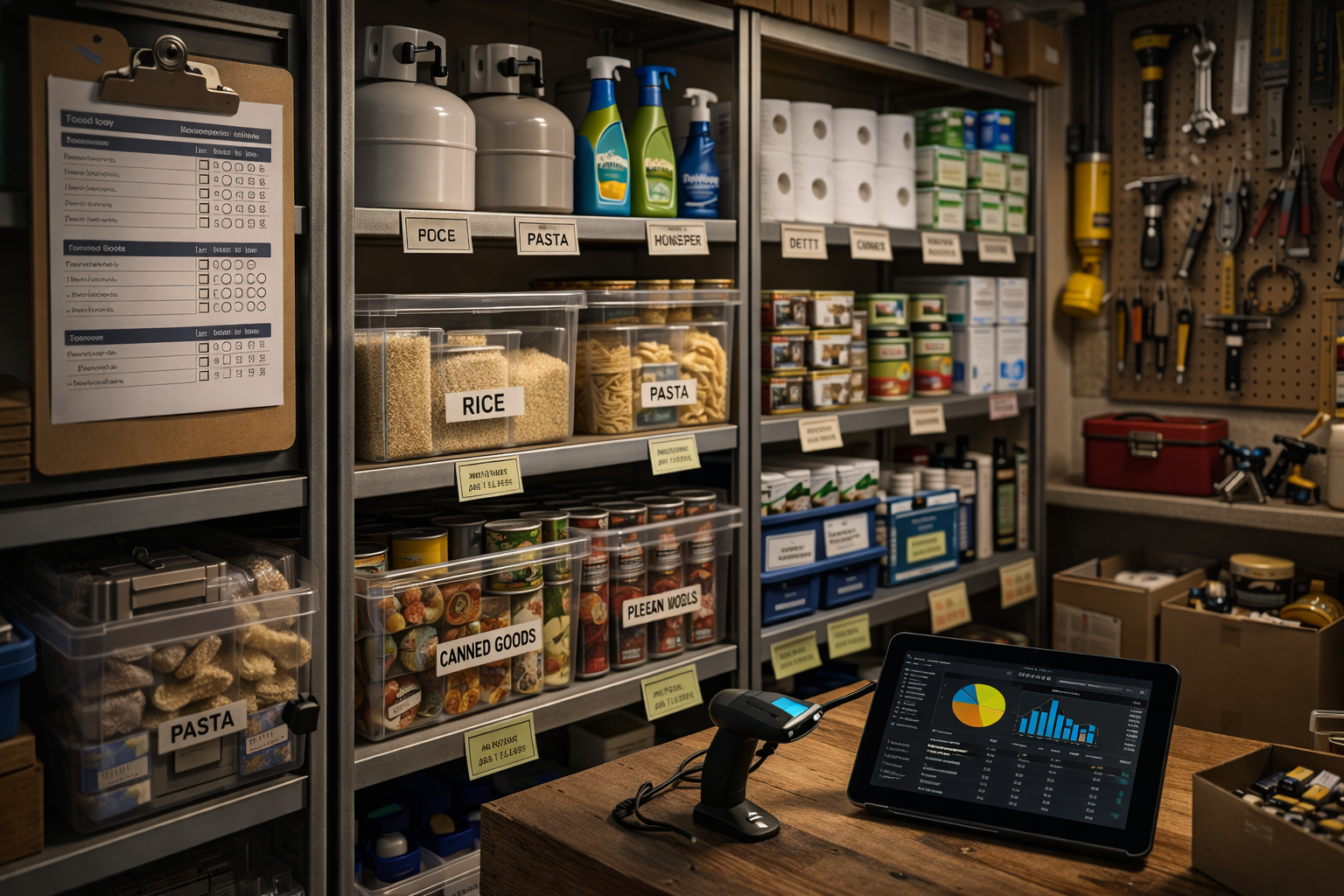
Inventory Management is the science of tracking every resource that enters and exits your domestic environment. In a high-performance home, you are the logistics manager of a small-scale fulfillment center.
Most households operate on a “Crisis-Purchase” model, buying items only when they have already run out. This reactive behavior creates unnecessary stress, wasted fuel, and high costs due to lack of planning.
Domestic Systems Engineering applies industrial “Supply Chain Logic” to ensure you always have exactly what you need. This article explains how to build a professional-grade inventory system for your food, tools, and consumables.
Learn how to eliminate the “Last-Minute Run” to the store and replace it with a rhythmic flow of assets. A well-managed home is never “out of stock” because the system anticipates the need before it becomes a problem.
The Concept of the “Domestic Warehouse”
Every home is a warehouse, whether the residents realize it or not, storing thousands of individual SKUs. The goal of inventory management is to bring visibility and order to these stored physical assets.
Stop viewing your pantry or your cleaning closet as random storage areas for disorganized goods. View them as “Active Inventory Zones” that require periodic auditing and strategic replenishment protocols.
By treating your home as a warehouse, you shift from a consumer mindset to a manager mindset. Visibility into your stock levels is the primary requirement for a resilient and efficient lifestyle.
Identifying the “Critical SKUs”
Not every item in your home requires the same level of tracking or inventory precision. Identify your “Critical SKUs”—the items that would cause a systemic failure if they were unavailable.
This includes essential food staples, hygiene products, medications, and specific maintenance components like filters. Focus your primary logistics energy on these items to ensure 100% availability at all times.
Non-critical items can be managed with less rigor to save your cognitive energy for the essentials. Knowing what truly matters allows you to build a lean but robust supply chain for your family.
The Par-Level Replenishment Strategy
“Par-Level” is the minimum amount of an item you must have on hand to meet your needs until the next delivery. If you use one gallon of milk per week and shop once a week, your “Par” is two gallons.
When your inventory drops below the Par-Level, it triggers an automatic “Reorder Point” in your system. This ensures you always have a “Safety Buffer” to handle unexpected guests or delayed shopping trips.
Engineering your Par-Levels prevents the frustration of discovering an empty shelf at the worst possible moment. It creates a predictable rhythm for your finances and your time, reducing the chaos of daily life.
Visual Management and Labeling
A professional inventory system must be “Visual” so that any resident can understand the status at a glance. Use clear bins for storage to make the remaining volume of an item immediately obvious to the eye.
Label every shelf and bin with the name of the item and its designated “Par-Level” number. This removes the “Guesswork” from the replenishment process and ensures that items are returned to their correct address.
Visual management reduces the “Mental Load” of remembering what you have and what you need. When the system is visible, the inventory manages itself through simple observation and habit.
The “One-In, One-Out” Protocol
To prevent the accumulation of “Inventory Bloat,” implement a strict “One-In, One-Out” protocol for all non-consumables. If you buy a new kitchen tool or a new pair of shoes, an old one must exit the system.
This prevents the “Entropy” of clutter from overwhelming your storage capacity and degrading your organization. It forces a constant evaluation of the “Utility Value” of every physical asset inside your home.
Keeping your inventory lean ensures that you can find what you need quickly and efficiently. A high-performance home is a place of high utility, not a graveyard for forgotten and unused purchases.
Implementing a Digital Inventory Tracker
While visual cues are powerful, a digital tracker provides long-term data and automation for your home logistics. Use a simple spreadsheet or a dedicated inventory app to log your “Critical SKUs” and their expiration dates.
Digital tracking allows you to see “Consumption Trends” and adjust your Par-Levels based on actual usage. It also provides a “Shopping List” that is always accurate and ready for your next replenishment cycle.
Technology should serve as the “Accounting Layer” of your domestic supply chain, providing precision and history. A digital record is the “Source of Truth” that prevents duplicate purchases and wasted resources.
The Logistics of “Bulk Acquisition”
Buying in bulk is a strategic move that reduces the cost per unit and the frequency of replenishment trips. However, bulk acquisition requires an “Infrastructure of Storage” to prevent the items from degrading.
Only buy in bulk those items that have a long shelf life and a high, predictable consumption rate. Ensure you have the “Bin Capacity” to house the bulk items without encroaching on your living space.
Bulk buying is an engineering trade-off between “Storage Cost” and “Purchase Efficiency” for the household. When done correctly, it builds a massive “Resilience Buffer” that protects you from price spikes and shortages.
Managing the “Perishable Flow”
Perishable items like fresh produce and dairy require a “Short-Cycle” logistics plan to avoid waste. Use a “Whiteboard” on the refrigerator to list the items that must be “Eaten First” based on their expiry.
Design your meals around the current “Perishable Inventory” to ensure that nothing is ever thrown away. Food waste is a failure of logistics and a direct loss of your financial and environmental resources.
Engineering the flow of perishables requires a tighter feedback loop and more frequent inventory checks. A “Zero-Waste” kitchen is the hallmark of a master domestic logistics engineer.
Tool and Hardware Inventory
Logistics isn’t just for food; it applies to the tools and hardware needed to maintain the “Home System.” Maintain an “Essentials Bin” with common screws, nails, fuses, and lightbulbs that are frequently required.
Inventory your primary tools and ensure they are stored in a “Ready-State” for immediate repair tasks. If you borrow a tool, it must be logged “Out” and “In” to prevent the loss of your maintenance assets.
A missing tool during a home repair is a “Logistics Break” that can double the time and cost of the job. Keep your hardware organized and accounted for to ensure your home remains in peak condition.
The “Audit and Purge” Ritual
Once every quarter, perform a “Full-Scale Inventory Audit” of every storage zone in your home. Check for expired goods, broken tools, and items that have not been used in the last twelve months.
Perform a “Purge” of items that no longer serve a functional purpose in your current domestic system. This ritual “Resets” the inventory and ensures that your storage remains optimized for current needs.
An audit is the “Quality Control” phase of your domestic supply chain, catching errors and “Inventory Drift.” Continuous improvement is the only way to maintain a high-performance logistics system over time.
Frequently Asked Questions
- Does this take too much time? It takes 15 minutes a week to save hours of shopping and searching.
- Do I need fancy software? No, a simple paper list or a basic spreadsheet works perfectly.
- What if I have a small house? Small houses need better logistics to maximize limited storage space.
- Is bulk buying always better? Not if you end up throwing away half of the items due to spoilage.
The Structural Rule of Inventory Management
If you don’t know what you have, you don’t actually have it when you need it. Engineer your inventory today so your home never runs out of the fuel it needs to function.

Adam Hulk is a professional barista, sensory analyst, and dedicated coffee educator with over a decade of experience in the specialty coffee industry. His journey began in the high-altitude farms of Colombia, where he spent a year studying the delicate relationship between volcanic soil and bean density.