
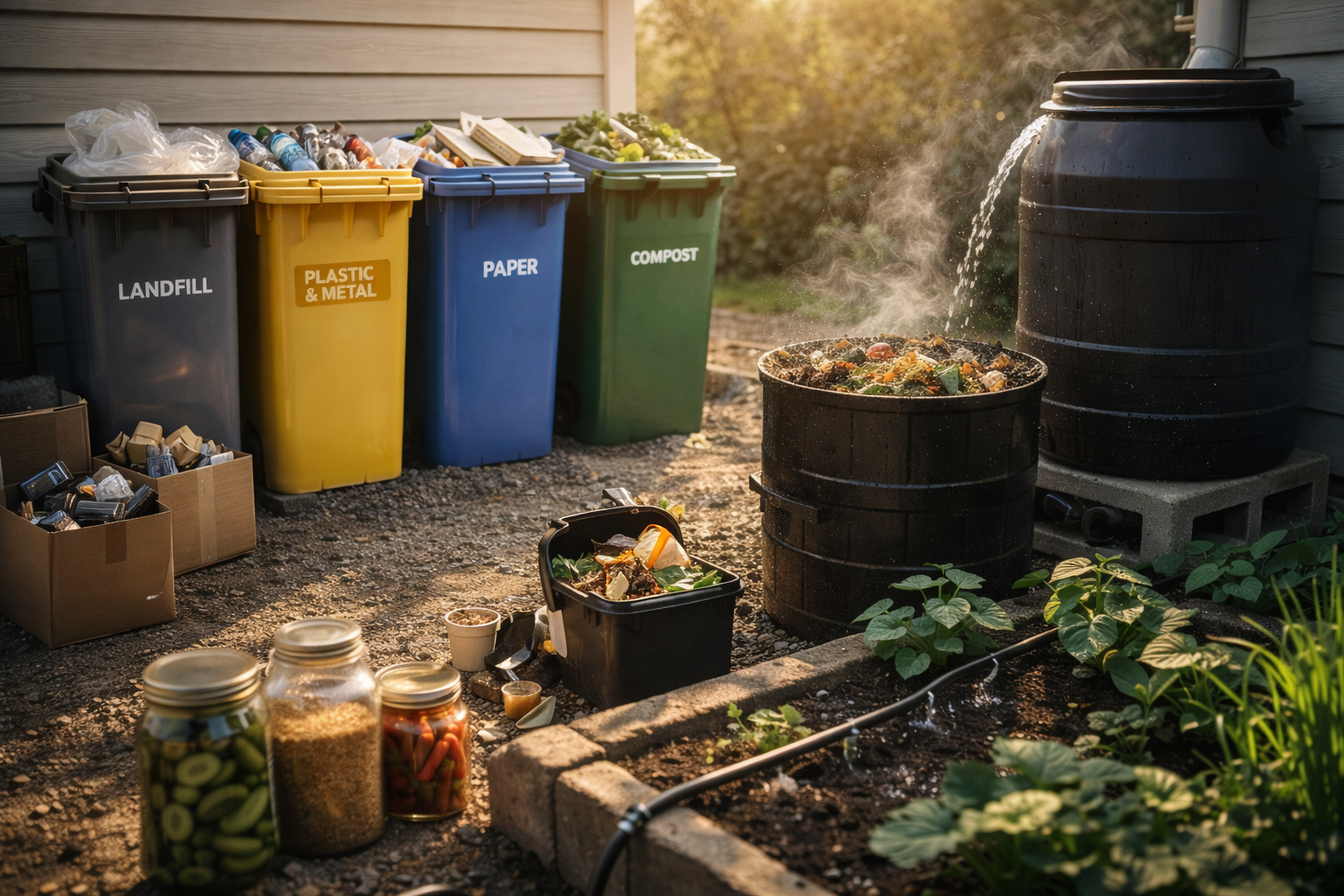
The Circular Economy is the strategic redesign of how a household handles the “output” of its daily operations. In traditional home management, resources follow a linear path of “take, make, and dispose,” leading to massive waste.
Domestic Systems Engineering rejects this linear model in favor of a closed-loop system where waste becomes a resource. By engineering your home’s output, you reduce your environmental footprint while simultaneously lowering your operational costs.
This article explores the logistics of turning “trash” into raw materials for your home’s internal ecosystem. Learn to manage your household’s waste stream as a professional-grade recovery operation rather than a disposal chore.
A high-performance home is defined not just by what it consumes, but by how efficiently it recycles what remains. Moving toward a circular model is the ultimate expression of domestic efficiency and long-term resource sustainability.
The Logic of the Closed-Loop System
The closed-loop philosophy treats every piece of “waste” as a potential input for another domestic sub-system. Food scraps become fertilizer for the garden, while greywater becomes irrigation for non-edible landscape plants.
This systemic approach reduces the “Net Outflow” of resources and lessens your dependency on external waste services. In a circular home, the goal is to keep materials in use for as long as physically possible.
Engineering this loop requires a shift in perspective from seeing “trash” to seeing “secondary raw materials.” Efficiency is found in the gaps where most people simply see a full garbage can or a drain.
Sorting Infrastructure as a Logistics Hub
A successful circular economy begins with a high-efficiency “Sorting Hub” located at the primary point of waste generation. The kitchen is the logistics center for most household output and requires a multi-bin system for rapid categorization.
Standardize your bins for organic compost, clean recyclables, specialized hazardous waste, and unavoidable landfill trash. Label these bins clearly to ensure that every resident follows the sorting protocol without requiring constant supervision.
Proper sorting at the source prevents the cross-contamination that makes recycling or composting impossible. A well-engineered sorting hub is the “Data Entry” point of your physical waste management software.
Composting: The Biological Recovery Unit
Composting is the process of recycling organic matter back into the nutrient-dense soil required for home food production. In a circular home, food waste is not a burden but a valuable nitrogen source for the garden’s “Soil Bank.”
Implement a tiered composting system using a kitchen-counter collector and a larger outdoor anaerobic or aerobic bin. Engineering the correct “Carbon-to-Nitrogen” ratio ensures that the decomposition process is odorless and highly efficient.
By “recovering” your organic waste, you eliminate the need to purchase expensive, chemical-heavy fertilizers. Composting is the biological heart of the circular economy, turning today’s leftovers into tomorrow’s harvest.
Greywater Reclamation and Irrigation
Greywater is the relatively clean waste water from baths, sinks, and washing machines that can be reused on-site. Instead of sending this water directly into the sewer, a resilient home diverts it to subsurface irrigation systems.
Engineering a greywater loop requires using biocompatible soaps and detergents that do not harm the soil biology. This practice can reduce a home’s total fresh water consumption by up to 30% depending on the household size.
Water is a finite resource that should perform at least two functional tasks before it exits your property. Greywater reclamation is a high-impact logistics project that provides massive returns during periods of drought.
The “Repair and Refurbish” Workshop
A circular economy requires a dedicated space for maintaining and repairing physical assets to extend their lifecycle. The “Home Workshop” is the maintenance node where broken tools, furniture, and electronics are given a second life.
Maintaining a small inventory of spare parts, adhesives, and fasteners allows for immediate “Triage and Repair.” Extending the life of a single appliance by two years represents a significant financial and resource saving.
Repairing an item is always more energy-efficient than recycling it and purchasing a brand-new replacement. A high-performance home is one where the residents possess the tools and skills to defy planned obsolescence.
Hazardous Waste and Battery Management
Batteries, electronics, and chemicals represent “Hazardous Output” that cannot be handled by traditional waste streams. Establish a dedicated “Safe Storage Container” for these items to prevent them from leaking into the domestic environment.
Engineering the disposal of these materials involves scheduled trips to professional recycling centers or “Take-Back” programs. Never treat hazardous waste with the same casualness as paper or plastic, as it threatens your home’s bio-security.
Proper management of toxins is a requirement for maintaining a healthy and resilient domestic living space. A clean output stream is a sign of a disciplined and professionally managed resource logistics system.
Upcycling as Creative Resource Recovery
Upcycling is the process of transforming waste materials into products of higher quality or functional value. Empty glass jars become high-performance storage for the pantry, while old textiles become cleaning rags.
This creative recovery reduces the need to purchase “Single-Use” organizers and disposable cleaning supplies. It requires an “Opportunity Mindset” where you look at every discarded object for its hidden potential.
Upcycling is the ultimate form of “Zero-Cost” infrastructure development for the resourceful domestic engineer. Your trash is often the raw material for your next home improvement or organization project.
Managing the Information Waste Stream
In the digital age, “Data Waste” and physical mail represent a significant security and organization burden. Implement a “Shredding Protocol” for all sensitive documents to prevent identity theft and physical clutter.
Digitize essential paper records immediately and recycle the physical copies once the “Digital Backup” is verified. Reducing the physical volume of paper in your home simplifies your logistics and improves your mental clarity.
Information waste is a form of “Cognitive Friction” that slows down the operational efficiency of the household. Clear your physical and digital mailboxes daily to maintain a lean and responsive domestic system.
The Procurement Filter: Pre-cycling
Pre-cycling is the logistical practice of preventing waste from entering your home in the first place. This involves selecting products with minimal packaging or choosing durable goods over disposable alternatives.
Every item you buy should be evaluated for its “End-of-Life” plan before it is allowed into your domestic system. If a product cannot be repaired, recycled, or composted, it should be treated as a last-resort purchase.
Engineering your procurement is the most effective way to manage your home’s total waste volume. The best way to handle waste is to never allow it to become a problem in your inventory.
Frequently Asked Questions
- Is composting smelly? Not if you balance green (nitrogen) and brown (carbon) materials correctly.
- Can I use greywater on vegetables? It is generally safer to use it only on non-edible landscape plants.
- Is upcycling worth the time? Yes, it saves money and reduces the need for new material acquisition.
- What is the most difficult waste to manage? Plastic packaging is the hardest to recover and should be avoided.
The Structural Rule of Circularity
A home that only knows how to consume is a home that is fundamentally fragile and wasteful. Engineer your recovery loops today so that your waste becomes the wealth of your domestic future.

Adam Hulk is a professional barista, sensory analyst, and dedicated coffee educator with over a decade of experience in the specialty coffee industry. His journey began in the high-altitude farms of Colombia, where he spent a year studying the delicate relationship between volcanic soil and bean density.