
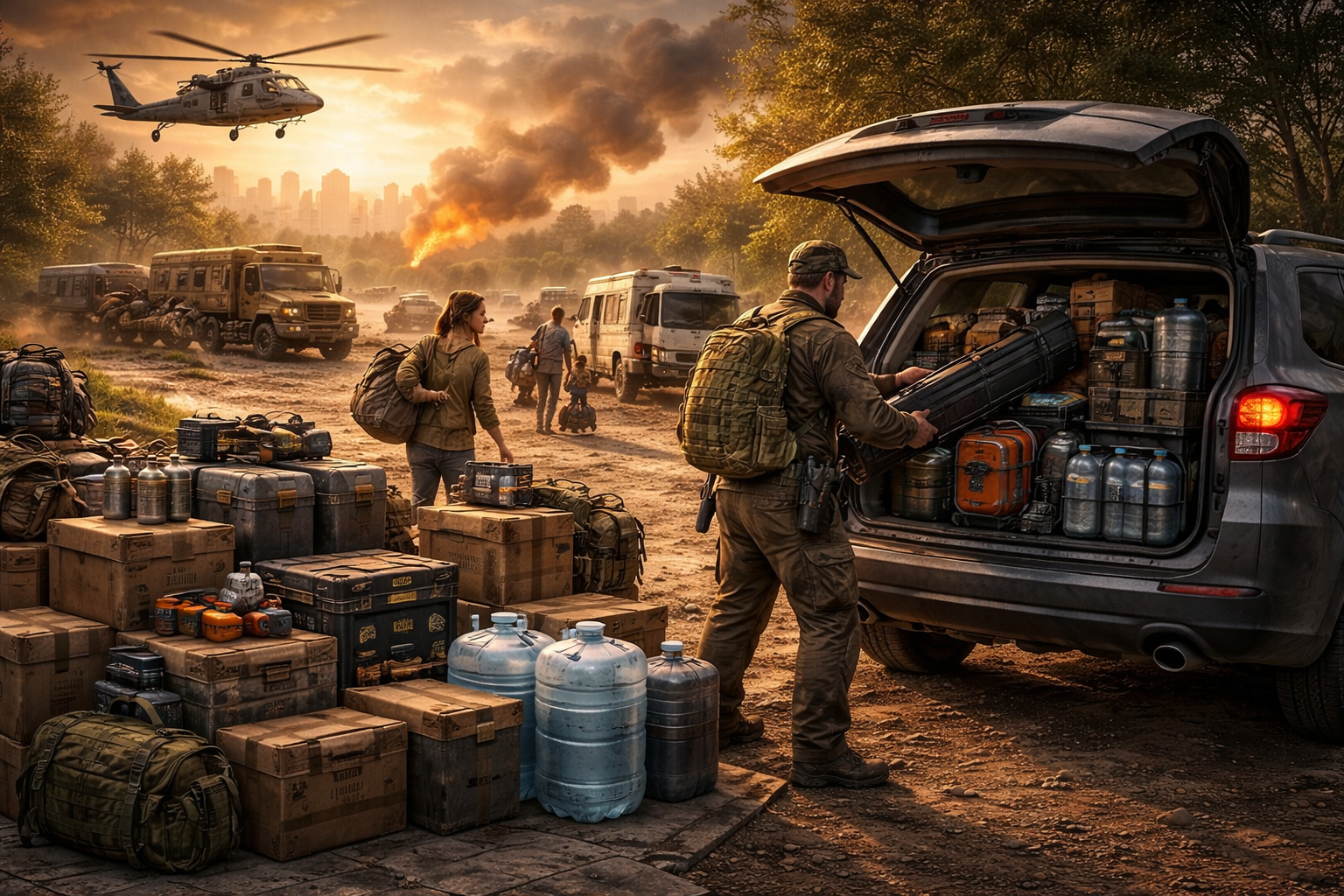
The Logistics of Evacuation is the strategic operation of relocating your critical household assets during a high-threat event. In Domestic Systems Engineering, evacuation is not a retreat but a “Mobile Deployment” of your core survival infrastructure.
Most people wait until an order is given to begin packing random items into a vehicle under extreme psychological stress. This reactive behavior leads to the loss of vital tools, disorganized resource management, and potentially fatal delays in departure.
This final article details how to engineer a “Rapid Mobilization” plan that ensures your family and assets move as one. Learn to categorize your inventory into “Tiered Load-Outs” that can be deployed in minutes rather than hours.
Mastering the logistics of motion ensures that your resilience is not tied to a single, vulnerable geographic coordinate. A high-performance home is a modular system that can be packed, transported, and re-established wherever safety is found.
The Logic of the “Phased Departure”
A phased departure is a logistical framework that matches your evacuation speed to the urgency of the external threat. Phase 1 is the “Immediate Exit,” where only life-saving kits (IFAKs) and the “Grab-and-Go” binder are taken.
Phase 2 is the “Primary Evacuation,” involving the deployment of 72-hour bags and pre-staged food and water modules. Phase 3 is the “Full Relocation,” where high-value tools, long-term supplies, and domestic hardware are systematically loaded.
By engineering these phases, you eliminate the “Analysis Paralysis” that occurs when trying to decide what to save. Logistics management ensures that the most critical assets are always the first to be loaded into the transport vehicle.
The “Go-Bag” as a Modular System
The “Go-Bag” is the primary unit of mobile logistics, containing the minimum resources needed for 72 hours of autonomy. Every resident must have a personalized bag that is weight-optimized and tailored to their specific biological and functional needs.
Engineer these bags as “Modular Systems” where medical, thermal, and nutritional sub-kits can be accessed without unpacking the whole. Standardize the exterior of the bags for rapid identification and use durable, high-visibility materials for easy tracking in low light.
A Go-Bag is a “Life-Support Node” that must be maintained in a constant state of readiness near your primary exit. Discipline in maintaining these bags ensures that your mobile logistics are ready for an “Instant-Start” deployment.
Vehicle Staging and Load-Out Maps
The transport vehicle is the “Mobile Warehouse” that carries your domestic assets from the danger zone to a safe harbor. Create a “Load-Out Map” for your vehicle that specifies exactly where every bin, bag, and fuel canister must be placed.
A pre-defined map ensures that the vehicle remains balanced for safe driving while maximizing every cubic centimeter of storage space. It also ensures that “High-Frequency” items, like first aid or water, remain accessible without unloading the entire cargo.
Practice loading your vehicle according to the map to identify any physical constraints or weight-limit violations before the crisis. Engineering the “Fit” of your assets is the difference between a secure transport and a chaotic, dangerous pile of gear.
Fuel Logistics for Long-Range Motion
Evacuation often involves long distances and massive traffic congestion that can drain a vehicle’s fuel tank rapidly. Maintain a “Secondary Fuel Reserve” of at least 20 liters of stabilized gasoline in a dedicated, spill-proof container for the vehicle.
This reserve acts as your “Get-Home” or “Get-Away” buffer, ensuring you don’t become stranded in a high-risk “Choke Point.” Calculate your vehicle’s “Full-Load Range” to know exactly how far you can travel before the logistics of refueling become critical.
Fuel is the “Kinetic Energy” of your evacuation; without it, your mobile domestic system becomes a stationary liability. Logistics management ensures that you have the range needed to reach your secondary or tertiary safe locations.
The Communication “Rally Point” Protocol
Mobile logistics requires a “Command and Control” protocol to ensure that family members remain coordinated if separated. Establish three “Rally Points” at varying distances from your home (Local, Regional, and Out-of-State) for meeting up.
Every resident must know the “Primary Route” and at least two “Alternative Paths” to reach these designated coordinates. Include physical maps and compasses in every Go-Bag to ensure navigation is possible without relying on GPS or cellular data.
Communication logistics is a matter of “Movement Synchronization,” ensuring that everyone knows the mission and the destination. A rally point provides the “Final Target” that guides your mobile deployment through the chaos of a disrupted environment.
Asset Security During Transit
Moving high-value assets during an evacuation creates a significant “Security Risk” from theft or opportunistic interference. Utilize opaque bins and “Stealth Packaging” to hide the nature of your supplies from casual observation by outsiders.
Never leave your loaded vehicle unattended in unsecured areas, and maintain a “Shift-Watch” protocol if you must stop for rest. Keep defensive tools and high-intensity lighting within reach of the driver and the “Tactical Navigator” in the passenger seat.
Transit security is the “Escort Layer” of your mobile logistics, protecting the resources that will rebuild your future. A resilient home remains defensive even when its walls have been replaced by the shell of a transport vehicle.
The “Medical Transit” Kit
Medical needs do not stop during an evacuation; in fact, the risk of injury increases during the physical labor of moving. A specialized “Medical Transit Kit” should be placed in the passenger compartment for immediate access during the drive.
This kit should focus on “Motion Sickness,” “Minor Trauma,” and “Sanitation” to keep the occupants functional and healthy. Include “Waste Management” solutions for the vehicle to maintain hygiene during long periods of entrapment in traffic.
Engineering your health in motion ensures that the residents arrive at the destination ready to establish the new site. Mobile medical logistics is a requirement for maintaining the “Human Resource” during the most stressful phase of a crisis.
Managing Digital and Virtual Assets
Evacuation is the most critical time to ensure that your “Information Assets” are fully synchronized and portable. Verify that your “Encrypted Portable Drive” is in the binder and that all cloud backups were completed before the power went out.
Turn off “Location Services” on non-essential devices to prevent the digital tracking of your movements by unauthorized parties. Maintain a “Digital Silent” protocol to preserve battery life and reduce the “Electronic Signature” of your evacuation.
Virtual logistics provide the “Data Continuity” that allows you to manage your finances and legal affairs from the road. Your digital footprint must be managed with the same tactical precision as your physical footprint on the highway.
The “Reverse Logistics” of Returning Home
A complete evacuation plan must also include the “Reverse Logistics” of returning to your home once the threat has passed. Document the “Baseline Condition” of your home before you leave to assist with later insurance claims or structural audits.
Have a “Re-Entry Protocol” that includes checking for structural damage, gas leaks, and water contamination before moving back in. Reverse logistics ensures that the transition back to “Primary Operations” is as safe and organized as the departure.
Knowing when and how to return is the final step in the cycle of domestic resilience and resource management. A successful return marks the victory of your engineering over the temporary disruption of the external environment.
Frequently Asked Questions
- When should I leave? When the “Cost of Staying” exceeds the “Risk of Moving”; always leave earlier than you think.
- Should I take my pets? Yes, but they require their own “Pet Go-Bags” with food, water, and restraint hardware.
- What if the roads are blocked? This is why you audit “Alternative Routes” and carry “Off-Road” recovery tools.
- How much water do I need for the car? Store at least 15 liters of water in the vehicle at all times for the occupants.
The Structural Rule of Evacuation Logistics
Your home is where your family and your resources are; if the building is a trap, the home must move. Engineer your mobilization today so you can carry your safety with you whenever the world demands it.

Adam Hulk is a professional barista, sensory analyst, and dedicated coffee educator with over a decade of experience in the specialty coffee industry. His journey began in the high-altitude farms of Colombia, where he spent a year studying the delicate relationship between volcanic soil and bean density.