
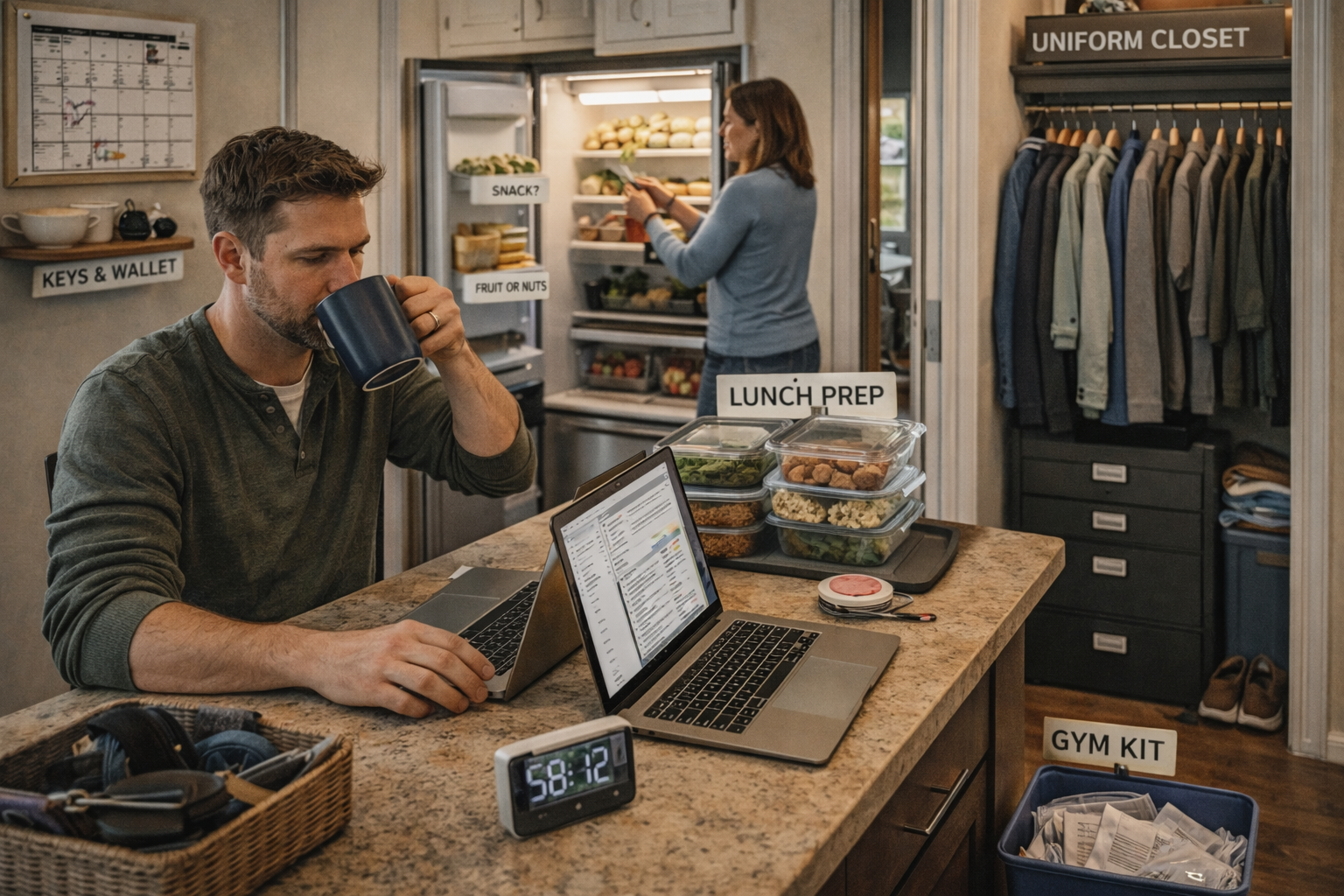
Decision architecture is the practice of organizing your physical environment to reduce the number of choices you make daily.
Every decision, no matter how small, consumes a measurable amount of glucose in the brain.
Choosing what to wear, what to eat, or where the keys are depletes your cognitive reserve.
By the evening, this leads to “decision fatigue,” resulting in poor choices and systemic stress.
A high-performance home is not just organized; it is architected to make the right choice the default choice.
This article explores how to build a structural framework that protects your mental energy through environmental design.
Why Cognitive Energy Is Your Home’s Most Valuable Asset
A home is managed by the mind.
If the mind is exhausted, the home systems collapse.
Most people focus on saving money or time, but ignore mental bandwidth.
Cognitive energy is a finite daily resource.
Architecture should serve as an external hard drive for your brain.
The Science of Decision Fatigue
The prefrontal cortex has a limited capacity for executive function.
Repeatedly making trivial choices “tires” the brain’s muscle.
This leads to impulsive behavior and procrastination later in the day.
Reducing the decision load preserves your willpower for high-value tasks.
Design the environment to eliminate the trivial.
Mapping the “Choice Points” in Your Daily Routine
A choice point is any moment where you must pause and decide.
What should I cook? Where is the remote? Should I workout?
Identify these moments throughout your morning and evening.
Every pause is a leak in your cognitive efficiency.
The goal is to transform choice points into automated flows.
The Concept of “Default Options” in the Home
In software, defaults guide the user.
In a home, the “default” is what happens when you are on autopilot.
If the default is a bowl of fruit on the counter, you eat fruit.
If the default is hidden gym gear, you don’t exercise.
Design the defaults to align with your long-term goals.
Why Visual Clutter Is a Decision Trap
Every object in your field of vision demands a micro-decision.
“Should I move this? Does this belong here?”
Even if you ignore it, your brain processes the presence of the object.
Minimalism is not about style; it is about reducing the visual “noise” that drains energy.
Clear surfaces lead to a clear executive function.
The Architecture of the “Uniform” Closet
Choosing clothes is a high-cost decision early in the day.
Limiting your wardrobe to a cohesive palette or a “uniform” eliminates this step.
Structure your closet so that any top matches any bottom.
Complexity in dressing is a tax on your morning focus.
Simplicity is the highest form of cognitive protection.
Why Meal Planning Is a Structural Requirement
“What’s for dinner?” is the most stressful question of the day.
Deciding while hungry and tired leads to systemic failure (takeout/waste).
Decide once a week, not once a day.
The menu is the “law” of the kitchen for that cycle.
Planning is a gift from your rested self to your tired self.
Managing the “Entry Point” Fatigue
The moment you enter the home is a critical transition.
If there is no designated “landing strip” for keys, mail, and bags, you must decide where to put them.
This creates immediate friction.
A structural landing strip automates the transition from “outside” to “inside.”
Logic at the door prevents chaos in the living room.
Why Everything Needs a “Permanent Address”
Searching for lost items is the ultimate cognitive drain.
When an item has no fixed home, you must decide its location every time you use it.
A permanent address removes the decision.
If it’s not in use, it is in its address.
Order is the absence of choice regarding location.
The Role of “Kitting” in Decision Architecture
Kitting is grouping all items needed for a specific task together.
A coffee kit, a workout kit, or a bill-paying kit.
If you have to gather parts from three rooms, the friction may stop you.
The kit makes the decision to start the task easier.
Proximity drives performance.
Designing the “Path of Least Resistance”
Humans naturally follow the easiest path.
If the recycling bin is inside a difficult cabinet, people will use the trash.
Place the tools for good habits in the direct flow of movement.
Place the temptations behind physical barriers.
Use physics to guide your psychology.
Why Digital Notifications Are Decision Parasites
Every “ping” asks: “Should I look at this now or later?”
This is a decision you didn’t ask for.
Architect your digital home by disabling non-human notifications.
Control the entry of information to protect your focus.
Your attention is not for sale to your apps.
The Logic of the “Pre-Decided” Evening
The evening is when willpower is lowest.
Do not decide your morning routine at 11 PM.
Lay out your clothes, pack your bag, and set the coffee timer.
The evening self serves the morning self.
Continuity of care is a systemic habit.
Why Choice Paralysis Is a Real Threat to Order
Too many options lead to no action.
Limit your choices in every category—from tea flavors to cleaning products.
A curated home is a functional home.
Abundance without structure is just clutter.
The Importance of “Systemic Reminders”
Don’t use your brain to remember to change the air filter.
Use a calendar or a physical tag on the device.
Outsource your memory to the environment.
The more you “know” without thinking, the more you can “think” about what matters.
Why Kitchen Layout Dictates Nutritional Choices
If healthy food is at eye level and processed food is on a high shelf, you will eat healthier.
This is “choice architecture” in action.
You are the architect of your own temptations.
Rearrange the shelves to support the system.
The Hidden Cost of “Open-Ended” Tasks
Tasks without a defined “done” state create mental loops.
“I should clean more” is a decision that never ends.
“I will clean for 15 minutes” is a closed logic.
Define the boundaries of your effort.
Why Your Workspace Needs a “Reset Protocol”
Ending work without a reset forces a decision the next morning: “Where do I start?”
A clear desk is a decision-ready desk.
The reset is the final act of the work batch.
Preparation is the foundation of flow.
The Role of Lighting in Cognitive Architecture
Dim light in the morning forces the brain to “decide” to wake up.
Bright light facilitates the transition.
Use smart lighting to automate the circadian logic of the home.
Biological alignment reduces the effort of living.
Why You Should Audit Your “Micro-Frictions”
A drawer that sticks. A light switch that’s out of reach.
These are micro-frictions that demand a tiny bit of attention.
Accumulated, they create a “heavy” home feeling.
Fix the friction to lighten the cognitive load.
Teaching the Household the “Architecture of Respect”
Systems fail when users don’t follow the design.
Explain the “why” behind the addresses and kits.
When everyone understands the logic, the system becomes self-sustaining.
Shared architecture reduces interpersonal friction.
The Psychology of “Decision Fasting”
Give your brain periods of zero decisions.
A walk without music or a phone.
A “do nothing” hour.
Recovery is as important as architecture.
Why Financial Decisions Should Be Batched
Checking bank balances daily creates constant micro-stress.
Batch financial reviews to a specific “Finance Hour.”
Automation is the ultimate decision protector for money.
The Impact of Soundscapes on Mental Bandwidth
Uncontrolled noise forces the brain to decide to ignore it.
Use white noise or acoustic treatments to create a stable environment.
Silence is a structural asset.
Why Success Is Measured in “Automaticity”
The more of your day that happens automatically, the more successful your architecture.
Automaticity is the goal of every Structural Habit.
Leave the thinking for the big problems.
Documenting the “Rules of the House”
Write down the addresses and the kits.
A physical manual for the home removes the “What should I do?” question for guests and family.
Transparency is efficiency.
Why You Should Avoid “Emergency” Shopping
Shopping under pressure leads to bad decisions and clutter.
The archive (from the previous article) prevents the need for emergency choices.
Stay ahead of the need.
The Long-Term ROI of Cognitive Protection
When you protect your brain, you perform better at work and in relationships.
The home becomes a charging station, not a drain.
The architecture pays for itself in mental health.
Frequently Asked Questions
- Doesn’t this make life boring? No, it makes the boring parts fast so the interesting parts can happen.
- How do I start? Start with your keys and your morning coffee.
- Is this for everyone? Especially for those with high-stress jobs or neurodivergence.
- What if I like variety? Architect your variety into planned blocks.
The Structural Rule of Decision Architecture
If your home environment forces you to think about where things are or what to do next, the architecture has failed.
Design for the person you are when you are most tired.

Adam Hulk is a professional barista, sensory analyst, and dedicated coffee educator with over a decade of experience in the specialty coffee industry. His journey began in the high-altitude farms of Colombia, where he spent a year studying the delicate relationship between volcanic soil and bean density.