
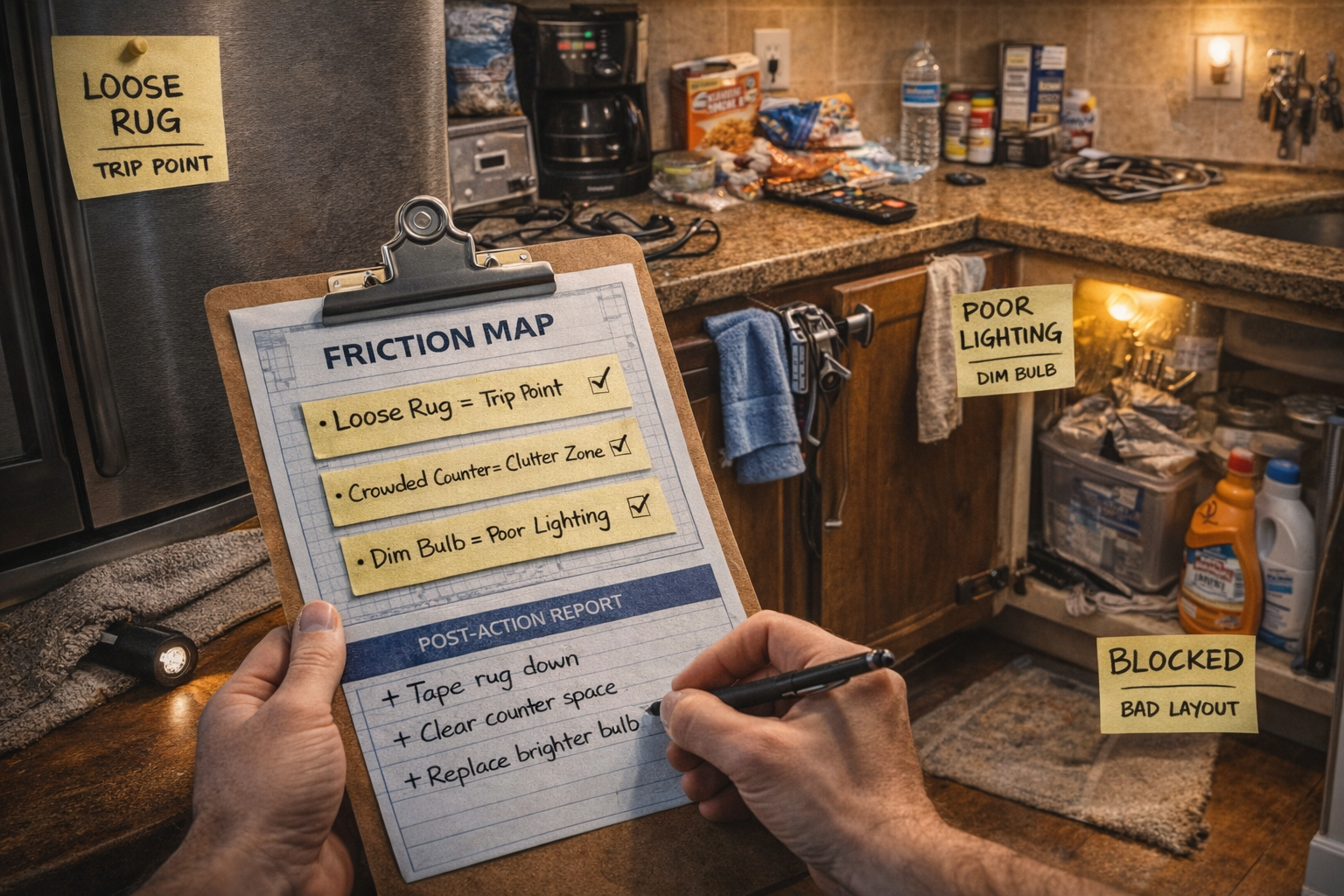
Friction mapping is the analytical process of identifying physical and environmental obstacles that slow down your household operations. In industrial design, friction is anything that prevents a user from completing a task with ease.
In the home, friction often goes unnoticed because we adapt to it through “habitual compensation.” You learn to step over the loose rug, hunt for the remote, or reach behind three boxes to find the detergent.
These micro-annoyances seem trivial, but they act as a “tax” on your daily momentum. Accumulated friction leads to procrastination, frustration, and systemic inefficiency. High-performance home systems require a “frictionless” environment where movement is fluid and intuitive.
This article explains how to audit your space to identify and eliminate the physical blocks in your daily routine.
The Physics of Domestic Resistance
Friction is a force that opposes motion. In a home, this motion is the flow of your daily “tasks” or “batches.” If you have to move two objects to reach a third, you have created physical resistance. If a drawer is difficult to open, you are less likely to put things away.
Mapping these points allows you to see the “invisible” weights you are carrying. Efficiency is the path of least resistance.
The Concept of “Habitual Compensation”
Humans are remarkably good at working around problems rather than fixing them. You develop a specific “move” to close a broken door or a “trick” to make an appliance work. This compensation consumes “background” mental energy. You shouldn’t have to be an expert in your home’s flaws just to survive a Tuesday. Identify where you are “compensating” and you will find your friction points. Stop adapting to the problem; solve the architecture.
Why Every “Second-Guess” Is a Friction Point
Friction isn’t just physical; it’s cognitive. If you have to think, “Which light switch is for the porch?” every night, that is friction. Labeling, color-coding, or logical grouping removes the second-guessing. The goal is “muscle memory” living. A home should be navigable in the dark without a single moment of doubt. Certainty is the opposite of friction.
The “Path of Travel” Audit
Walk through your most common routines: making coffee, getting dressed, or leaving the house. Notice every time you have to change direction, backtrack, or move an obstacle. If the coffee mugs are on the opposite side of the kitchen from the coffee maker, your path is inefficient. A frictionless path is a straight line or a logical circle. Rearrange your inventory to match your movement.
Why “The Threshold” Is the Highest Friction Zone
The entry and exit of the home are the most complex transition points. Friction here causes you to be late or to bring stress into the house. Is there a designated spot for your keys, wallet, phone, and bag? If you have to “find” these items, your threshold is high-friction. Design a “Zero-Friction Landing Strip” to automate the exit and entry.
Mapping the “Clutter Hotspots”
Clutter is frozen friction. It is a collection of items that don’t have a “Permanent Address” or are too difficult to put away. Identify the surfaces where paper or clothes always accumulate. Usually, this happens because the “Correct Destination” is too far or too hard to reach. Bring the destination to the hotspot or remove the friction of the storage. The environment dictates the behavior.
The Logic of “One-Touch” Storage
Every extra step in a storage process increases the likelihood of failure. If you have to open a closet, move a bin, and unlatch a lid, you won’t do it. Aim for “one-touch” or “no-touch” storage for frequent items. Open bins, hooks instead of hangers, and magnetic strips are low-friction tools. Simplify the access to simplify the order. Complexity is the mother of mess.
Why Sound and Light Can Be Friction Sources
A flickering light or a buzzing fan creates “sensory friction.” It irritates the nervous system and makes tasks feel more difficult than they are. Poor lighting in a workspace makes you squint and tire faster. Fix the sensory environment to lower the “barrier to entry” for work. Comfort is a functional requirement, not a luxury.
The “Stuck Drawer” Syndrome
Physical defects in hardware act as psychological blocks. If a cabinet door is crooked, you subconsiously avoid that area of the kitchen. This leads to “inventory rot” where items in high-friction zones are never used. Maintain your hardware to maintain your flow. A drop of oil on a hinge can save five minutes of frustration per week.
Why Digital Friction Is the New Household Block
A slow Wi-Fi dead zone or a complicated smart-home app is modern friction. If it takes three clicks to turn on a light, the system is flawed. Digital tools should accelerate life, not demand more attention. Audit your “user interface” with your home’s technology. If the tech is frustrating, it’s not smart.
The Role of “Proximity Logic” in Tool Storage
Tools should be stored at the “Point of Use.” Cleaning supplies for the bathroom should stay in the bathroom. Scissors should be in every room where you open packages. The friction of “going to the other room” to get a tool often stops a task before it starts. Duplicate low-cost tools to eliminate high-cost movement.
Dealing with “Visual Friction” in Interior Design
Patterns that are too busy or colors that clash can create a feeling of unrest. Visual friction prevents the “Recovery Phase” of the home. Simplify the visual field to allow the brain to reset. A “quiet” room is a low-friction room for the eyes.
How to Audit Your “Morning Sequence”
Track the time between waking up and leaving the house. Where are the bottlenecks? Is it the shower? The wardrobe? The breakfast? If two people need the same space at the same time, that is structural friction. Offset the schedules or add a second “station” (like a mirror in the bedroom). Flow is about managing the “traffic” of the inhabitants.
The Impact of “Decision Overload” as Friction
If your pantry has ten types of pasta, you have to choose. Choice is a cognitive friction. Standardize your basics to remove the need for thought. A curated life is a frictionless life. Reduced options lead to increased action.
Why You Should “Watch the Water”
Observe where water or dirt accumulates. A sink that splashes or a rug that doesn’t stay put. These are physical signals from the environment that the design is wrong. Address the physical symptoms to cure the systemic friction.
The “Lid and Cap” Tax
Small repetitive actions like unscrewing jars or opening latches add up. For items you use daily, consider lidless containers or pump dispensers. Remove the “tax” of the packaging. Every second saved is a second returned to your life.
Friction Mapping for Social Harmony
Identify which chores cause the most arguments. Often, the argument isn’t about the chore, but the friction of the chore. If taking out the trash is difficult because the bags always rip, fix the bags. Lower the friction of the “unpleasant” tasks to increase compliance. Engineering can solve “laziness.”
The Relationship Between Ergonomics and Friction
If a counter is too low, your back hurts, and you avoid the task. Physical discomfort is a major friction point. Adjust your environment to fit your body’s geometry. An ergonomic home is a frictionless home.
Using “Pilot Runs” to Test New Layouts
Before committing to a renovation or a new furniture layout, test it. Move the items and live with them for a week. Does the friction decrease or increase? Data-driven design is superior to aesthetic-driven design.
Why Success Is Measured in “Silence”
A frictionless home operates quietly and smoothly. No slamming doors, no searching for keys, no frustrated sighs. The absence of “noise” (physical and mental) is the ultimate metric.
Teaching the Household to Report Friction
Create a culture where family members “call out” blocks. “The vacuum cord is too short” or “I can’t reach the top shelf.” Identify the problem, map it, and solve it. The home is an evolving prototype.
The Financial Cost of Friction
Friction leads to wasted time and “convenience” spending. You buy takeout because the kitchen is too frustrating to use. Eliminating friction is a form of financial management. The easier it is to live, the cheaper it is to live.
Frequently Asked Questions
- Is everything friction? No, some resistance is good (like safety locks), but 90% of household resistance is accidental.
- What if I can’t move my walls? Focus on the inventory and the “Path of Travel” within the existing walls.
- How often should I map? Every time your life changes (new job, new baby, new hobby).
- Is this just being picky? It’s being precise. Precision is the foundation of high performance.
The Structural Rule of Friction Mapping
If a task feels “heavy” or “annoying,” it is rarely because you are lazy; it is usually because the environment is fighting you. Find the block, remove the friction, and reclaim your flow.

Adam Hulk is a professional barista, sensory analyst, and dedicated coffee educator with over a decade of experience in the specialty coffee industry. His journey began in the high-altitude farms of Colombia, where he spent a year studying the delicate relationship between volcanic soil and bean density.