
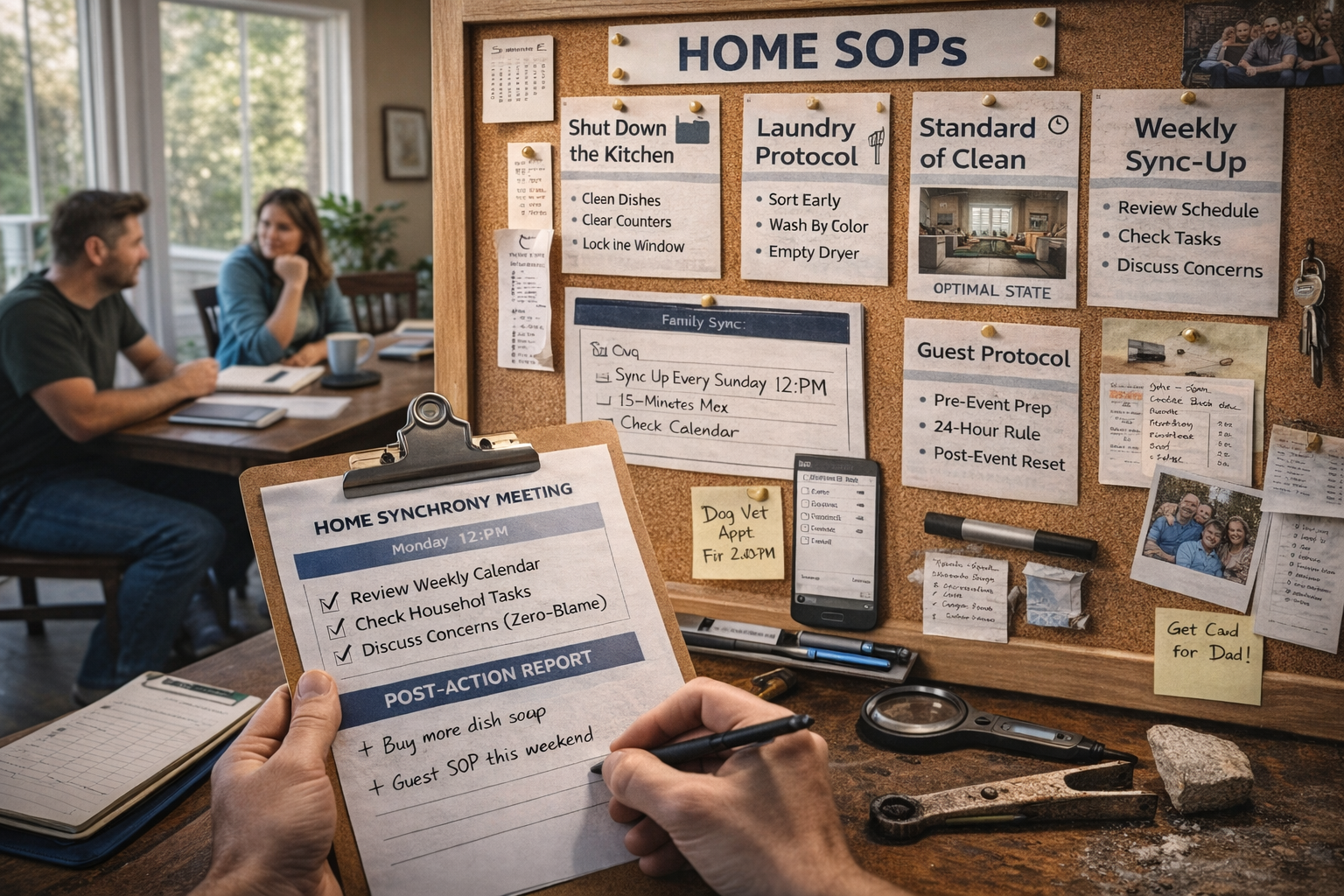
The Social Contract of the home is the invisible structure of cooperation.
Most households run on assumptions.
Assumptions lead to resentment.
Resentment leads to systemic collapse.
A high-performance home requires explicit rules.
We call these Shared Operating Procedures (SOPs).
These are not just chores.
They are the “code” for how the house functions.
This article explains how to build a social architecture.
Learn to replace nagging with logic.
Create a home that works for everyone.
Why Assumptions Are Systemic Risks
One person thinks the dishes “should” be done at night.
Another thinks morning is fine.
This gap is where conflict lives.
Ambiguity is the enemy of harmony.
Implicit expectations are never met.
Explicit rules are easy to follow.
Turn “should” into “must.”
Define the standard of the system.
The Concept of the “Household SOP”
An SOP is a written guide for a task.
“How we close the kitchen.”
“How we process the mail.”
It defines the “Done” state.
It removes the “I didn’t know” excuse.
Structure provides safety for all residents.
A shared logic is a shared peace.
Mapping the “Responsibility Zones”
Ownership must be individual.
“Everyone” is responsible for nothing.
“One person” is responsible for the Zone.
Divide the house into clear sectors.
Zone A is the kitchen.
Zone B is the laundry.
The owner dictates the flow of that zone.
Accountability requires a single name.
The Logic of “Labor Equity”
Equity is not always a 50/50 split.
It is a balance of “Total Load.”
Some tasks are physically heavy.
Some are mentally draining (the mental load).
Audit the total energy required by the home.
Distribute based on capacity and schedule.
Fairness is a calculated value.
Why You Need a “Home Synchrony” Meeting
Communication cannot be random.
Random talk leads to missed data.
Schedule a 15-minute weekly sync.
Review the calendar.
Review the “Archive” needs.
Review the “Reset” status.
A planned meeting prevents daily friction.
Synchronize the operators of the system.
The “Standard of Clean” Protocol
“Clean” means different things to different people.
Define your household’s baseline.
Does “clean” mean sanitized?
Or does it mean “tidy”?
Take photos of the “Optimal State.”
Use these as a visual reference.
Objective standards remove subjective arguments.
Managing the “Mental Load”
The mental load is the “Project Management” of the home.
Knowing when the milk is out.
Knowing when the dog needs shots.
This is often invisible labor.
Bring the mental load into the light.
Use shared digital lists for inventory.
Outsource the “remembering” to the system.
Why “Nagging” Is a System Failure
Nagging is a symptom of a broken SOP.
It means the cue didn’t work.
Or the responsibility was unclear.
If you have to nag, fix the system.
Don’t fix the person.
Change the environment or the rule.
Nagging is a waste of social capital.
The “Guest Protocol” for the Social Contract
How do we handle visitors?
Who cleans before they arrive?
Who handles the post-event reset?
Build a “Guest SOP.”
This prevents stress during social events.
Hospitality should not break the residents.
Using the “24-Hour Rule” for Friction
Conflict is inevitable in any structure.
Implement a “Cool-Down” buffer.
Wait 24 hours before discussing a system breach.
Speak about the “Protocol,” not the “Person.”
“The SOP wasn’t followed” is better than “You forgot.”
Keep the language technical and neutral.
The Role of “Shared Digital Infrastructure”
Use one shared calendar.
Use one shared shopping list app.
Single sources of truth prevent overlap.
They prevent “I thought you bought it.”
Digital harmony supports physical harmony.
Why “Solo Maintenance” Destroys the Contract
If one person does everything, they become a martyr.
Martyrs eventually burn the system down.
Every resident must contribute to the “Code.”
Even children must have a small SOP.
Contribution is a form of belonging.
The “Zero-Blame” Retrospective
If a system fails, ask “Why?”
Was the instruction unclear?
Was the tool broken?
Was the time block too small?
Fix the architecture first.
Blame is the least efficient response.
Teaching “Systemic Respect” to Children
Children are junior operators.
Teach them the “Logic of the Address.”
Teach them the “Batching Protocol.”
Frame chores as “System Maintenance.”
It builds pride in the environment.
They are learning to be architects.
The “Emergency Override” Clause
Life happens.
People get sick.
Jobs get intense.
The Social Contract must have a “Grace Clause.”
“I am at capacity; I need a system override.”
Temporary redistribution prevents permanent cracks.
Why You Should Document the “House Rules”
Write the top 5 SOPs down.
Keep them in the “Home Manual.”
This is not for control.
It is for clarity.
New residents or guests can adapt quickly.
Documentation is the “RAM” of the household.
The Financial Impact of Social Harmony
Conflict is expensive.
It leads to “escape spending.”
Eating out to avoid a messy kitchen.
Buying duplicates because of poor communication.
A solid social contract is a budget tool.
Success Is Measured in “Low Voice Volume”
A home with clear SOPs is a quiet home.
There is no need for shouting.
There is no need for frantic questions.
Everything is “pre-decided.”
Silence is the sound of a working contract.
The Long-Term ROI of Shared Procedures
The home becomes a place of true rest.
You are not “managing” people all day.
You are living within a functioning loop.
The contract builds trust over years.
Frequently Asked Questions
- Is this too clinical? It feels clinical for a week, then it feels like freedom.
- What if my partner refuses? Start with your own zones and show the results.
- Can kids really do this? Yes, they love clear boundaries.
- Do we need a contract for everything? No, only for the points of friction.
The Structural Rule of the Social Contract
Don’t let your relationships pay the price for a bad house system.
Build the rules together.
Trust the process.
Let the system be the boss.

Adam Hulk is a professional barista, sensory analyst, and dedicated coffee educator with over a decade of experience in the specialty coffee industry. His journey began in the high-altitude farms of Colombia, where he spent a year studying the delicate relationship between volcanic soil and bean density.